
Jul 30
Jul 30
Jul 29
Jul 22
Jul 19
Jul 17
From sugary desserts to endless snacks, the holiday season is tough on your teeth. While enjoying your favorite treats, it’s important not to neglect your oral health. In this guide, we share professional, science-backed oral care tips for the holiday season, including how to prevent acid erosion, manage sugar intake, and make smart use of smart toothbrushes like BrushO to stay on top of your dental routine — even when traveling or indulging.
The holiday season introduces several risk factors for your oral health:
• Frequent snacking keeps your mouth acidic and plaque-active throughout the day.
• Sugary desserts like pies, cookies, and candies fuel cavity-causing bacteria.
• Alcohol and acidic drinks like wine and soda can weaken enamel.
• Traveling often disrupts your regular brushing routine.
Left unchecked, these habits can lead to plaque buildup, sensitivity, bad breath, and even holiday-time cavities.
Brushing before meals — especially sugary or acidic ones — coats teeth with fluoride, offering extra protection.
Avoid brushing immediately after acidic meals or wine, as this can damage softened enamel. Rinse with water and brush after 30 minutes instead.
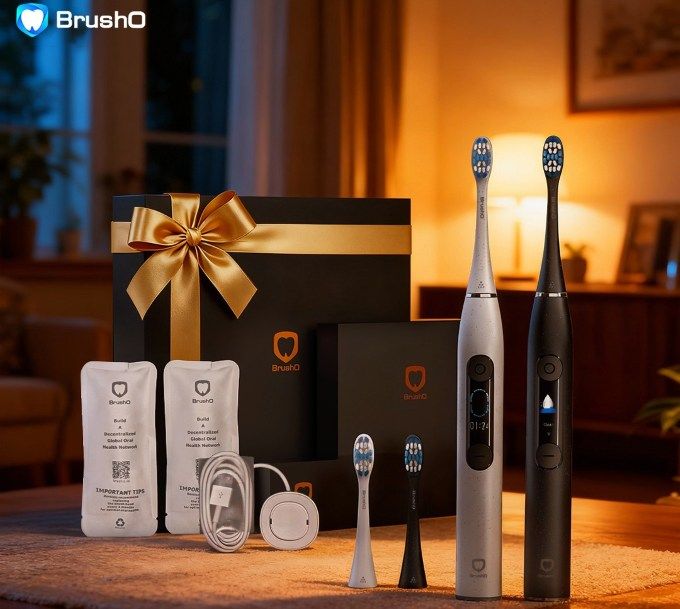
BrushO’s AI-guided brushing, pressure feedback, and travel-friendly design help you brush more effectively, even on busy holiday mornings or evenings.
Features include:
• Zone-based coverage (6 zones, 16 surfaces)
• Pressure monitoring to protect gums and enamel
• Brushing score to keep track of your performance
• Rechargeable long battery life (ideal for travel)
A quick rinse with water or sugar-free mouthwash helps neutralize acids and clear debris, especially when snacking frequently.
Don’t forget your toothbrush, fluoride toothpaste, floss, and if possible, a portable charging base for your BrushO smart brush.
• Choose wisely: Dark chocolate is better than sticky candy like caramel.
• Timing matters: Eat sweets after meals instead of random snacking — saliva is most active right after eating.
• Stay hydrated: Water dilutes sugars and supports natural cleaning by saliva.
• Chew sugar-free gum after meals to increase saliva flow and reduce acid buildup.
Whether you’re flying or staying with relatives, don’t skip your brushing routine. Here’s how BrushO helps:
• Compact & Travel-Ready: Long battery life and wireless charging.
• App Reminders: Set notifications to stay on schedule.
• Brushing History: Sync data when you’re back online.
• Brush & Earn: Even on holiday, every brush earns rewards via the BrushO ecosystem.
Holiday meals often include garlic, onions, or alcohol — all of which contribute to bad breath. Don’t forget to:
• Clean your tongue
• Stay hydrated
• Use BrushO’s deep-clean mode for extra freshness
The holidays are for joy, not cavities. With a few mindful steps and the help of smart brushing technology like BrushO, you can enjoy every bite while keeping your teeth clean, your gums healthy, and your breath fresh. Don’t let holiday feasting undo your year-round efforts — stay consistent, stay smart, and stay smiling.
Join BrushO and enjoy your Christmas feast without worry.
Dec 22
Dec 22
Jul 30
Jul 30
Jul 29
Jul 22
Jul 19
Jul 17

Hyperdontia is the presence of one or more teeth in excess of the normal dental formula, and the resulting teeth are described as supernumerary. The condition is common enough to appear in routine practice but variable enough in presentation that the decision to intervene is rarely straightforwar...

Few patients complete orthodontic treatment without asking whether their teeth will move back. The honest answer is that they will, to some degree, in the majority of cases. Relapse is not a failure of treatment but a predictable biological response, and understanding why it happens is the basis ...

The mandible is the largest and most frequently fractured bone of the facial skeleton, and its management sits at the interface between trauma surgery and restorative dentistry. Treatment has shifted over four decades from prolonged maxillomandibular fixation towards rigid internal fixation with ...

Chronic liver disease affects hundreds of millions of people worldwide, and its prevalence continues to rise with the epidemic of metabolic liver disease. The liver is central to haemostasis, drug metabolism and immune competence, and its failure therefore alters the risk profile of almost every ...

Excessive gingival display, commonly described as a gummy smile, is one of the most frequent aesthetic concerns presented to dental practitioners. The condition is not a single entity but a clinical presentation that can arise from skeletal, gingival, muscular or dental factors, and the treatment...

Drug-induced gingival overgrowth is a well-recognised adverse effect of several widely prescribed medications, and it remains one of the most common drug-related findings in periodontal practice. The condition produces firm, fibrous enlargement of the gingiva that can interfere with speech, masti...

Denture stomatitis is an inflammatory condition of the denture-bearing mucosa that affects a large proportion of removable prosthesis wearers, yet it is frequently dismissed as a cosmetic annoyance. The condition is driven by a Candida biofilm on the fitting surface of the prosthesis, and it is m...

Chronic kidney disease affects an estimated 850 million people worldwide, and the number of patients surviving on dialysis or with a renal transplant continues to rise. These patients carry an oral disease burden that is substantially higher than that of the general population, and their medical ...

Angular cheilitis is an inflammatory lesion of the labial commissures that presents with erythema, fissuring and crusting at the corners of the mouth. It is one of the most common conditions encountered in general dental practice, yet it is frequently treated as a simple fungal infection and allo...

Adverse reactions to dental materials are uncommon but they are not rare, and they are frequently misdiagnosed because the oral mucosa responds to allergens in a limited number of ways. A burning sensation, a persistent ulcer or an unexplained area of erythema may all represent a hypersensitivity...


Address: RM 1427, 14/F RADIO CITY 505, HENNESSY RD CAUSEWAY BAY, HONG KONG
Code: 000000
Phone: +852-53758652
Email: customerservice@brusho.com
