
Jul 30
Jul 30
Jul 29
Jul 22
Jul 19
Jul 17
Mornings can be hectic — you’re juggling alarms, emails, breakfast, and maybe even kids. In the rush to get out the door, oral hygiene often takes a backseat. But brushing your teeth, even in a hurry, doesn’t have to be sloppy or ineffective. In fact, a quick yet mindful routine can go a long way in protecting your teeth and gums. The key lies in using the right tools, the right technique, and a little bit of smart technology. Here’s how to brush better when you’re short on time — without compromising on your dental health.
When we’re in a hurry, we tend to:
• Skip hard-to-reach areas
• Brush too aggressively or too quickly
• Use improper technique
• Forget to clean the tongue or gumline
All of this can lead to plaque buildup, gum inflammation, and even bad breath — problems that compound over time.
Focus on:
• Front, back, and chewing surfaces
• Gumline and molars (most commonly missed)
• 30 seconds per quadrant (or smarter: 6-zone guidance)
Even if you have only 90 seconds, be intentional. Don’t just swipe — aim for complete, thorough coverage.
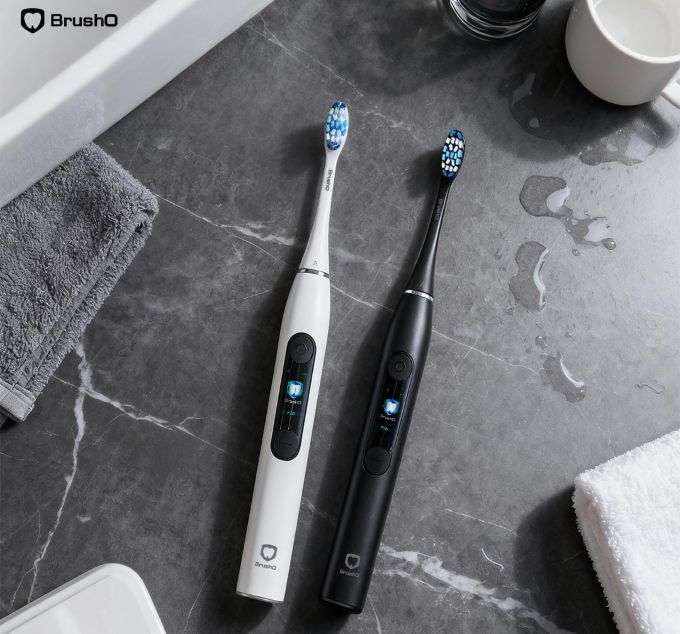
Smart toothbrushes like BrushO are designed for time-crunched mornings. With built-in zone tracking, real-time feedback, and pressure sensors, they help you stay on target — even when half-asleep. BrushO also uses AI to analyze your brushing habits and suggest improvements, so you don’t waste effort and still get a full clean.
With the BrushO App, you get:
• Guided brushing animations
• Personalized scorecards
• Missed-area detection
• Alerts when you’re brushing too hard or too fast
This automation takes the mental load off your morning routine.
Charge your brush. Fill your water cup. Set your mouthwash and floss within easy reach. Small prep steps can save crucial seconds in the morning.
Use music as your cue — it’s faster than watching the clock and makes brushing more enjoyable. BrushO’s app has a built-in timer and rhythm guidance to keep you moving efficiently.
If you’re really behind, skip flossing or mouthwash — but never skip brushing. It’s the foundation of oral health. You can always floss after lunch, but plaque begins building up within hours.
• Travel-ready design: Lightweight, slim, and fits in any bag
• 45-day battery life: No need to worry about charging every week
• Waterproof: Brush in the shower if you really need to multitask
• Quick-swap heads: Brush heads click off in seconds for fast cleaning or travel
You don’t need 10 minutes to brush effectively — you need precision, guidance, and consistency. With smart tools like BrushO, even your fastest brushing sessions can be highly effective. By forming better habits and relying on technology that thinks for you, you turn rushed routines into reliable self-care. Your smile deserves that — even on Monday mornings.
BrushO is a smart AI-powered toothbrush designed to fit real-life routines — busy mornings, tight schedules, and all. It uses advanced brushing zone tracking, real-time feedback, and personalized scoring to help users brush better, not just longer. From smart sensors to lifetime brush head rewards, BrushO makes oral care intelligent and intuitive.
Jul 30
Jul 30
Jul 29
Jul 22
Jul 19
Jul 17

The force that a fixed orthodontic appliance applies to a tooth depends on more than the bracket and the archwire. The way the archwire is secured inside the bracket slot, the ligation, determines how much of the wire's stored energy is transmitted to the tooth and how much friction resists the d...

The introduction of nickel-titanium (NiTi) rotary instruments has transformed modern root canal treatment, allowing curved canals to be shaped more rapidly and predictably than with stainless steel hand files. Yet every clinician who uses rotary systems must also manage a distinct hazard: instrum...

Between the diagnosis of a pulp problem and its definitive treatment, a clinician needs a dependable interim: a material that seals the cavity, protects the treated pulp, and holds the medicament until the next visit. Zinc oxide eugenol (ZOE) and its reinforced form, IRM, have served this role fo...

Clear aligner therapy has moved from a niche option to one of the most popular forms of orthodontic treatment, valued by patients for its appearance. Yet the aligner is not a magic appliance: a smooth plastic shell has limited ability to grip a tooth without help from attachments. Attachments, sm...

The way the teeth meet when the jaw moves is one of the most consequential decisions in restorative dentistry. In a canine-guided occlusion, the upper and lower canines take over the guidance of the mandible during lateral movements, so that the posterior teeth are disengaged and the load is carr...

Porcelain veneers are thin ceramic shells that are bonded to the facial surfaces of anterior teeth to improve their color, shape, alignment, and overall appearance. They have become one of the most requested esthetic procedures in modern dentistry because they offer predictable, long-lasting resu...

Myofascial pain is one of the most common causes of chronic pain in the head and neck region, yet it is frequently overlooked or misdiagnosed. It arises from hypersensitive bands within skeletal muscle, known as trigger points, which produce local tenderness and characteristic patterns of referre...

Inlay and onlay restorations are indirect restorations that replace missing tooth structure without the circumferential coverage of a full crown. An inlay fits within the cusps of a tooth, while an onlay extends over one or more cusps, distributing occlusal forces more favorably and preserving so...

The gingival biotype describes the thickness and form of the gingiva that surrounds the teeth, and it has become a central concept in periodontal therapy, implant dentistry, and restorative treatment planning. A thick biotype is associated with deeper probing depths, a scalloped gingival margin, ...

A posterior crossbite occurs when one or more of the upper back teeth bite inside the lower back teeth, so that the buccal cusps of the maxillary molars and premolars sit lingual to the mandibular cusps. It is one of the most common malocclusions in the mixed dentition and, when left untreated, i...

BrushO AI Electric Toothbrush offers real-time brushing guidance, pressure feedback, coverage tracking, and app-based progress reports for a cleaner daily routine.
BrushO AI Electric Toothbrush offers real-time brushing guidance, pressure feedback, coverage tracking, and app-based progress reports for a cleaner daily routine.


Address: RM 1427, 14/F RADIO CITY 505, HENNESSY RD CAUSEWAY BAY, HONG KONG
Code: 000000
Phone: +852-53758652
Email: customerservice@brusho.com