
Jul 30
Jul 30
Jul 29
Jul 22
Jul 19
Jul 17
Many office workers brush their teeth twice a day—once in the morning and once at night—but still suffer from dry mouth, bad breath, and even unexpected cavities. Why? The answer lies in the modern desk job routine: extended screen time, dehydration, poor posture, constant snacking, and rarely brushing during the day. This article examines why those working in offices are particularly susceptible to oral health issues, and how intelligent tools like BrushO can help mitigate this trend by promoting data-driven daily habits.
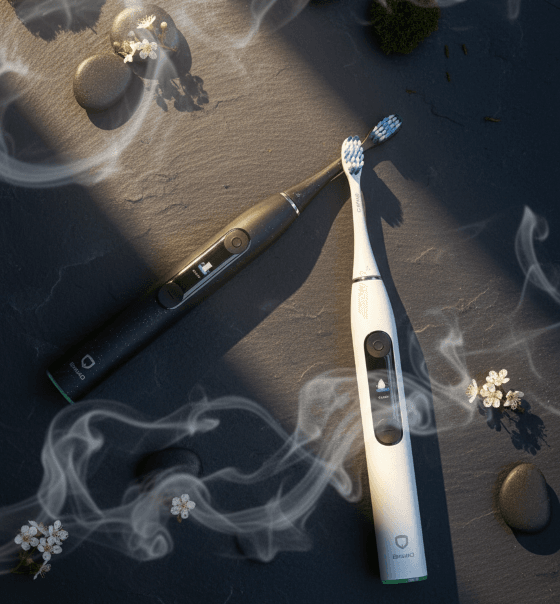
Office culture often encourages long hours, coffee breaks, and back-to-back meetings—but discourages mid-day brushing, hydrating properly, or even standing up frequently. These habits slowly erode oral health without employees realizing it.
• Reduced saliva flow from dehydration and prolonged screen time
• Frequent coffee, tea, or sugary drink consumption
• Skipping mid-day brushing or flossing
• High-stress environments increase inflammation and dry mouth
• Snacking on processed foods that stick to teeth
These combined create the perfect conditions for bacteria to thrive—leading to plaque, bad breath, and eventually, cavities or gum disease.
Dry mouth (xerostomia) is not just uncomfortable—it’s harmful. Saliva is your mouth’s natural defense mechanism. It washes away food particles, neutralizes acids, and helps repair enamel. When saliva production drops, harmful bacteria can flourish.
• Air conditioning dehydrates the air (and your mouth).
• Stress and multitasking reduce saliva production.
• Limited water intake throughout the day.
• Excessive caffeine suppresses salivary glands.
Cavities form when food particles and bacteria sit on your teeth, producing acids that erode enamel. For office workers:
• Snacking without brushing leaves sugar on your teeth for hours.
• Soft drinks, flavored water, or sugary coffee creamers increase acidity.
• Poor posture or mouth breathing during screen time can dry out your mouth and worsen decay risk.
Even if you brush morning and night, these daily patterns mean bacteria stay active for hours during the workday.
High-stress environments like fast-paced offices can impact oral health in subtle ways:
• Teeth grinding or jaw clenching (bruxism)
• Inflammation linked to periodontal disease
• Neglected routines when overwhelmed
Over time, stress becomes a silent contributor to both cavities and gum disease—especially when it leads to skipped brushing or poor dietary choices.
BrushO is designed to help busy professionals stay on top of oral health—even during hectic workweeks.
• Brushing reminders at optimal times (e.g., before/after work and lunch)
• Real-time feedback on pressure, coverage, and duration
• 6-zone coverage ensures back molars and gumlines aren’t missed
• Custom modes like sensitive or deep-clean for coffee drinkers
• $BRUSH token rewards motivate users to maintain consistent routines
• Daily habit tracking to catch inconsistent patterns
Even if brushing at work isn’t possible, BrushO ensures your morning and evening routines are maximized for effectiveness.
• Drink water regularly—set reminders every 30–60 minutes.
• Keep sugar-free gum at your desk to stimulate saliva.
• Rinse your mouth with water after coffee or snacks.
• If possible, keep a travel-size toothbrush at your desk.
• Use BrushO’s app insights to improve routines when you’re back home.
Office life may be great for productivity—but not for your teeth. Between coffee breaks, snack drawers, long meetings, and constant screen time, it’s easy to forget that your oral health is quietly being compromised. Fortunately, awareness combined with smarter tools can protect your smile. By using an AI-powered toothbrush like BrushO, you can fight back against dry mouth and cavities with smarter routines, personalized brushing plans, and real-time feedback—keeping your teeth healthy, even on your busiest workdays.
Jan 16
Jan 16
Jul 30
Jul 30
Jul 29
Jul 22
Jul 19
Jul 17

Thumb sucking and pacifier use are normal self-soothing behaviors in infancy, and most children give them up on their own by school age. The dental problem arises when the habit continues past the eruption of the permanent front teeth, because the persistent pressure reshapes the growing jaw and ...

Most people never think about the shape of their tooth roots, but root morphology determines how a tooth is treated when disease strikes. Taurodontism and dilaceration are two developmental anomalies that change root anatomy in distinctive ways, and both have major implications for endodontics, e...

Dental injuries are among the most common sports-related injuries, and a mouthguard is the simplest piece of equipment an athlete can wear. Yet many players still train without one, often because they have never been told which type to choose or how a well-fitted guard feels. Understanding the pr...

Piezoelectric surgery has changed the way oral surgeons cut bone. Instead of a rotating bur, a piezotome uses ultrasonic vibrations to cut mineralized tissue while leaving soft tissue largely untouched. The technique is now routine for osteotomies, sinus lifts and delicate procedures where precis...

Children's teeth vary naturally in size, but some variations are large enough to affect function, appearance and future orthodontic care. Microdontia means teeth that are smaller than normal, and macrodontia means teeth that are larger than normal, and both can appear as isolated findings or as p...

Two patients can have identical teeth and completely different treatment outcomes, and the reason is often hiding in the gums. Gingival biotype describes the thickness and morphology of the soft tissue around the teeth, and it influences how the gum reacts to surgery, implants, braces and even si...

Guided bone regeneration, or GBR, is the standard method for rebuilding bone before and around dental implants. The concept is simple: a membrane creates a protected space that allows bone-forming cells to grow while excluding competing soft tissue. Choosing a resorbable membrane changes the prot...

Periodontal disease destroys not only the gum but the bone and ligament that anchor teeth, and the goal of regenerative treatment is to rebuild all three. Emdogain, an enamel matrix derivative, has become one of the most studied biological agents for this task, and its results improve further whe...

A chipped tooth is one of the most common dental emergencies, affecting children and adults alike through falls, sports, biting on hard objects and even normal wear. The right repair depends less on the size of the fragment and more on which layer of the tooth is exposed. Bonding, veneers and cro...

A knocked-out tooth is one of the few dental emergencies where minutes decide the outcome. When a permanent tooth is completely displaced from its socket, immediate and correct handling can save it, while delays or mistakes can condemn it to loss. The steps are simple enough for any parent, coach...

แปรงสีฟันไฟฟ้า BrushO AI ให้คำแนะนำการแปรงแบบเรียลไทม์ ฟีดแบ็กแรงกด การติดตามพื้นที่แปรง และรายงานความคืบหน้าในแอป เพื่อกิจวัตรประจำวันที่สะอาดขึ้น
แปรงสีฟันไฟฟ้า BrushO AI ให้คำแนะนำการแปรงแบบเรียลไทม์ ฟีดแบ็กแรงกด การติดตามพื้นที่แปรง และรายงานความคืบหน้าในแอป เพื่อกิจวัตรประจำวันที่สะอาดขึ้น


Address: RM 1427, 14/F RADIO CITY 505, HENNESSY RD CAUSEWAY BAY, HONG KONG
Code: 000000
Phone: +852-53758652
Email: customerservice@brusho.com