
Jul 30
Jul 30
Jul 29
Jul 22
Jul 19
Jul 17
AI-powered toothbrushes are revolutionizing oral care—but what exactly do they track, and how does it help your daily brushing routine? This article breaks down the core tracking features of smart toothbrushes like BrushO, including real-time pressure monitoring, brushing angle correction, zone-by-zone surface coverage, and brushing habit reports. You’ll learn how these intelligent features go far beyond traditional brushing, enabling a personalized dental care experience and better long-term gum and tooth health.
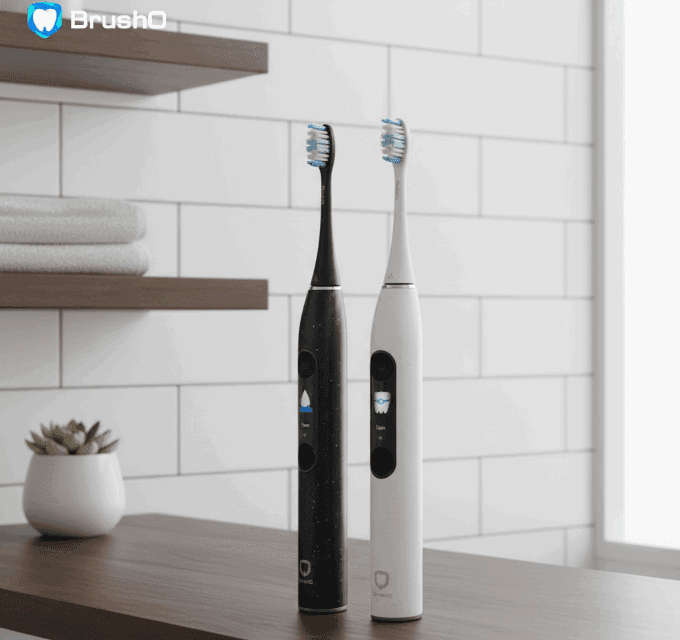
Electric toothbrushes have long outperformed manual ones in cleaning efficiency. Now, with AI and sensor technology, smart toothbrushes offer real-time feedback and personalized brushing guidance—turning oral care into a data-driven, habit-forming wellness routine. But what do these intelligent brushes actually measure? Let’s explore what sets them apart.
Excessive brushing pressure can damage enamel and irritate gums. One of the most important features an AI toothbrush tracks is brushing pressure.
• How It Works: Sensors embedded in the brush head detect when too much force is applied.
• BrushO’s Advantage: The brush vibrates or sends app notifications when you’re pressing too hard, helping reduce gum recession and enamel wear.
Why It Matters: Overbrushing is one of the most common causes of gum recession and tooth sensitivity. Real-time pressure tracking encourages a gentler and safer brushing technique.
Most people miss areas when brushing—especially the back molars and inner surfaces. AI toothbrushes use zone tracking to ensure you brush thoroughly.
• How It Works: BrushO divides the mouth into 6 zones × 16 surfaces and tracks which zones are cleaned during each session.
• Real-Time Feedback: Missed zones are flagged in the app report, prompting users to improve coverage next time.
Why It Matters: Incomplete brushing leads to plaque buildup, gum inflammation, and cavities—especially in hard-to-reach areas.
Correct brushing isn’t just about time—it’s also about the right angle and motion.
• BrushO’s Motion Sensors: Detect the angle of brushing and whether circular motions (recommended by dentists) are used.
• AI Optimization: The app provides brushing scores based on technique, not just time.
Why It Matters: Proper angles help clean under the gumline and between teeth. Angle analysis ensures more effective plaque removal and less wear on enamel.
Smart toothbrushes also track how long you brush and how consistent your brushing habits are.
• Two Minutes Standard: BrushO ensures each session meets the dentist-recommended 2-minute minimum.
• Consistency Reports: Daily, weekly, and monthly insights help users build and maintain healthy brushing habits.
Why It Matters: Skipping sessions or brushing too quickly compromises oral health. Time tracking reinforces discipline and routine.
Many people fail to brush along the gumline where plaque tends to accumulate. BrushO’s AI is trained to detect when this critical zone is missed.
• App Feedback: After each brushing session, users receive a heatmap showing areas lacking gumline contact.
• Gentle Modes: BrushO includes specialized brushing modes like “Gum Care” for safe and effective gumline cleaning.
Why It Matters: Gumline neglect leads to gingivitis and periodontal disease. Tracking this area helps users prevent long-term damage.
BrushO compiles all tracked data into personalized brushing scores and progress charts.
• Scoring Criteria: Based on pressure, zone coverage, duration, and brushing frequency.
• Gamification: Users can earn “Brush & Earn” tokens or rewards for maintaining high brushing scores.
Why It Matters: Visualization of your brushing behavior boosts motivation, builds long-term oral care habits, and makes brushing feel rewarding.
AI toothbrushes can even measure whether you’re brushing evenly across left vs. right, or top vs. bottom surfaces.
• BrushO’s Symmetry Metrics: Encourage users to maintain balance and avoid favoring one side unconsciously.
• Brushing Reports: Visual graphs help you self-correct over time.
Why It Matters: Imbalanced brushing can lead to plaque buildup on neglected sides, causing uneven wear or localized decay.
Based on all tracked data, BrushO’s AI continuously refines your brushing mode and suggestions.
• Adaptive Algorithms: Your brush can recommend switching to “Sensitive,” “Whitening,” or “Gum Care” modes depending on your history.
• Smart Tips: The app offers bite-sized suggestions after each session based on performance data.
Why It Matters: No two mouths are the same. Personalization leads to more effective, comfortable, and engaging oral care routines.
An AI toothbrush like BrushO doesn’t just clean your teeth—it coaches you through every brush. By tracking a wide range of metrics including pressure, zones, angles, duration, gumline focus, and brushing behavior, BrushO turns a daily task into a powerful health routine.
The result? Fewer cavities, healthier gums, more confidence—and a smarter approach to wellness.
Jan 29
Jan 29
Jul 30
Jul 30
Jul 29
Jul 22
Jul 19
Jul 17

The posterior maxilla is the most demanding site in implant dentistry, because the pneumatized maxillary sinus frequently leaves the clinician with less bone than the implant requires. Maxillary sinus augmentation, the surgical procedure that raises the sinus floor to create vertical bone, has be...

The rubber dam is the oldest and still the most effective isolation device in restorative dentistry, and its reputation as an inconvenient extra step survives among practitioners who have never measured the time it actually saves. The dam isolates the field from the saliva, the tongue, and the ch...

The margin is the most vulnerable line in fixed prosthodontics, because it is the only boundary between the prepared tooth, the restoration, and the oral environment that the clinician cannot fully seal by effort alone. A restoration that fits seamlessly at the margin resists leakage, caries, and...

The masticatory system is built for function, yet much of its damage comes from habits that serve no purpose. Parafunctional habits, the clenching, the grinding, and the tongue pressing performed outside of normal function, sit behind much of the tooth wear, the temporomandibular pain, and the my...

Chronic mouth breathing in the growing child is seldom a dental problem in origin and almost always a facial one in consequence. The child who sleeps with the mouth open bypasses the physiologic benefits of nasal respiration, and the posture that the airway forces upon the tongue, the mandible, a...

The immediate denture is the prosthesis placed on the day the teeth are extracted, sparing the patient the edentulous interval the conventional denture imposes and preserving the occlusal vertical dimension, the facial support, and the appearance through the transition. The clinical literature ha...

The Class III malocclusion in the growing child carries a special urgency, because the maxillary deficiency that marks the pattern does not correct itself and the window for the growth-modifying treatment closes with the skeletal maturity. Elastic protraction, the orthopedic therapy that pulls th...

The denture is the only prosthetic device in medicine that its owner is expected to wear daily and to clean personally, yet it is also the device most commonly neglected until the signs of disease appear. A biofilm that forms on the acrylic base within hours is a reservoir of candida and bacteria...

The complete denture stands or falls on the impression, because the impression determines how well the base follows the mucous membrane and how evenly the occlusal load is distributed across the basal seat. For a century the profession has argued about whether the impression should record the muc...

The all-ceramic crown has moved from a niche product to the default restoration for the anterior single tooth in a single clinical generation, driven by patient demand for metal-free appearance and by materials that now survive functional loading as reliably as their metal-ceramic predecessors. A...

BrushO AI Electric Toothbrush offers real-time brushing guidance, pressure feedback, coverage tracking, and app-based progress reports for a cleaner daily routine.
BrushO AI Electric Toothbrush offers real-time brushing guidance, pressure feedback, coverage tracking, and app-based progress reports for a cleaner daily routine.


Address: RM 1427, 14/F RADIO CITY 505, HENNESSY RD CAUSEWAY BAY, HONG KONG
Code: 000000
Phone: +852-53758652
Email: customerservice@brusho.com