
Jul 30
Jul 30
Jul 29
Jul 22
Jul 19
Jul 17
Caffeine is beloved for its energy-boosting benefits — but its effects don’t stop at your brain. This powerful stimulant also interacts with your mouth in surprising ways. From reducing saliva flow to contributing to enamel erosion, your daily coffee may be doing more harm than you think if you’re not brushing smart. In this article, we explore the science behind caffeine’s impact on your saliva and teeth, and how a smarter brushing routine with tools like BrushO can help balance your daily habits.
Caffeine is known to have diuretic properties, which can lead to dehydration. Dehydration, in turn, affects saliva production — a key factor in maintaining oral health.
Saliva helps wash away food particles, neutralize acids, and prevent bacterial overgrowth. When saliva is reduced, your mouth becomes more acidic, increasing the risk of cavities and bad breath.
Common signs of reduced saliva from caffeine:
• Dry mouth
• Sticky feeling in the mouth
• Morning breath even after brushing
Most caffeinated beverages (coffee, tea, energy drinks, sodas) are acidic. This acid can weaken enamel over time — especially when consumed frequently or sipped slowly over long periods.
• Acid exposure leads to:
• Tooth sensitivity
• Dull or yellowish appearance
• Higher susceptibility to cavities
Coffee and tea contain chromogens, which cling to enamel and cause tooth discoloration. A weakened enamel surface makes it easier for these pigments to stick.
Drink water alongside your coffee to combat the dehydrating effects. This helps maintain saliva flow and rinse away acids.
Wait at least 30 minutes before brushing your teeth. Brushing right after acid exposure may further damage softened enamel.
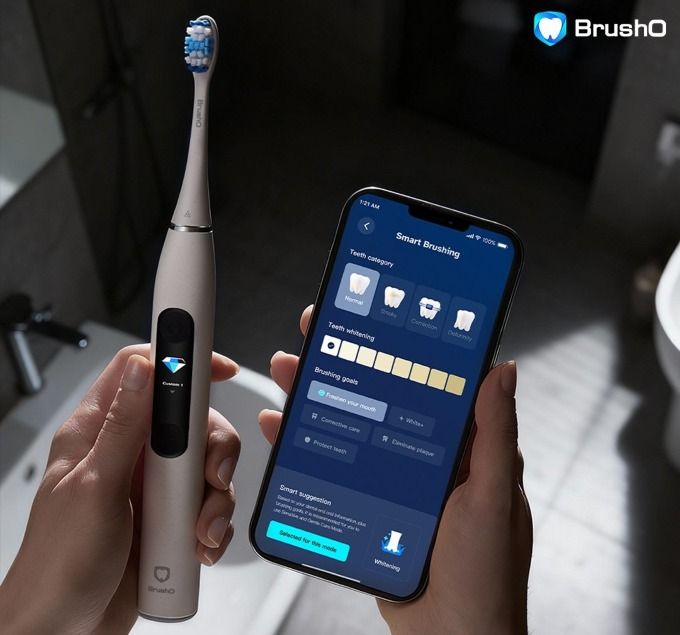
A smart brush like BrushO can help monitor pressure, ensure even coverage, and adapt to your enamel’s condition. Its feedback helps reinforce good brushing behavior, especially important for caffeine-heavy routines.
To counteract enamel loss, use fluoride or hydroxyapatite-based toothpaste that helps rebuild enamel over time.
BrushO’s AI brushing coach doesn’t just measure movement — it detects patterns that may indicate dry brushing or neglect of acid-prone areas. Pair it with saliva-promoting routines like chewing sugar-free gum or using a humidifier at night.
You don’t have to quit caffeine to protect your teeth — but you do need to understand its impact. By staying hydrated, timing your brushing properly, and using smarter oral care tools, you can enjoy your coffee without sacrificing your smile.
Jul 30
Jul 30
Jul 29
Jul 22
Jul 19
Jul 17

Trigeminal neuralgia (TN), also known as tic douloureux, is a chronic orofacial pain disorder characterized by recurrent, unilateral, brief, electric shock-like pain in the distribution of one or more divisions of the trigeminal nerve. It is widely regarded as one of the most severe pain conditions

Tooth whitening has become one of the most sought-after elective dental procedures worldwide. With increasing emphasis on facial aesthetics, a bright, white smile is now widely perceived as a marker of health, youth, and social confidence. This article provides a comprehensive review of contemporary

The edentulous posterior maxilla presents unique challenges for implant rehabilitation due to the pneumatization of the maxillary sinus and the progressive resorption of the alveolar ridge following tooth loss. Sinus floor elevation, or sinus lift surgery, is a predictable and well-documented surgic

Photodynamic therapy (PDT) is a minimally invasive therapeutic modality that combines a photosensitizing agent, light of a specific wavelength, and molecular oxygen to produce cytotoxic reactive oxygen species. Originally developed for oncological applications, PDT has been increasingly adopted in d

The introduction of temporary anchorage devices (TADs) has fundamentally transformed orthodontic treatment by providing skeletal anchorage that is independent of patient compliance. TADs, also known as mini-implants or miniscrews, enable tooth movements that were previously impossible or required co

Dental caries remains one of the most prevalent chronic diseases worldwide, disproportionately affecting children, elderly populations, and communities with limited access to conventional restorative care. The traditional restorative approach requires expensive equipment, cooperative patients, and m

Platelet-rich fibrin (PRF), a second-generation platelet concentrate, has emerged as one of the most widely adopted autologous biomaterials in contemporary dentistry and oral surgery. Developed by Dr. Joseph Choukroun and colleagues in France in 2001, PRF represents a conceptual evolution from first

The transition from conventional to digital impressions represents one of the most significant technological shifts in contemporary dentistry. Intraoral scanners (IOS) have evolved from experimental prototypes in the 1980s to sophisticated clinical instruments that now rival and, in several key metr

Gingival recession, defined as the apical migration of the gingival margin beyond the cementoenamel junction with exposure of the root surface, is a prevalent condition affecting a substantial proportion of the adult population. Epidemiological studies report that approximately 50% of adults exhibit

Cone beam computed tomography (CBCT) has revolutionized endodontic diagnosis and treatment planning by providing three-dimensional imaging that overcomes the inherent limitations of conventional periapical radiography. While two-dimensional radiographs remain the first-line imaging modality for endo

แปรงสีฟันไฟฟ้า BrushO AI ให้คำแนะนำการแปรงแบบเรียลไทม์ ฟีดแบ็กแรงกด การติดตามพื้นที่แปรง และรายงานความคืบหน้าในแอป เพื่อกิจวัตรประจำวันที่สะอาดขึ้น
แปรงสีฟันไฟฟ้า BrushO AI ให้คำแนะนำการแปรงแบบเรียลไทม์ ฟีดแบ็กแรงกด การติดตามพื้นที่แปรง และรายงานความคืบหน้าในแอป เพื่อกิจวัตรประจำวันที่สะอาดขึ้น


Address: RM 1427, 14/F RADIO CITY 505, HENNESSY RD CAUSEWAY BAY, HONG KONG
Code: 000000
Phone: +852-53758652
Email: customerservice@brusho.com