
Jul 30
Jul 30
Jul 29
Jul 22
Jul 19
Jul 17
Sugar is widely recognized as a leading contributor to tooth decay, yet environmental dryness may pose an equally significant — and often overlooked — threat. Dry air reduces saliva production, weakening the mouth’s natural defense system responsible for neutralizing acids, repairing enamel, and controlling harmful bacteria. When oral hydration drops, plaque becomes more aggressive and enamel more vulnerable, creating conditions that accelerate cavity formation even without high sugar intake. Understanding this physiological relationship helps individuals adopt preventative strategies and leverage advanced oral-care technologies to protect long-term dental health.
Sugar contributes to tooth decay by feeding acid-producing bacteria. However, cavities develop when protective mechanisms fail, not just when sugar is present.
Key protective mechanisms include:
• Saliva buffering acids
• Mineral replenishment of enamel
• Mechanical cleansing of food particles
• Microbial balance regulation
Dry air disrupts all of these defenses simultaneously, amplifying decay risk regardless of diet.
Saliva functions as the mouth’s primary protective system.
Saliva buffers pH levels, preventing prolonged enamel exposure to acid.
Calcium and phosphate in saliva repair microscopic enamel damage.
Antimicrobial proteins regulate harmful microbial populations.
Prevents plaque adhesion and bacterial concentration.
When saliva production decreases, these protections weaken dramatically.
Dry environments accelerate evaporation from mucosal surfaces, reducing saliva availability.
Common triggers:
• Air conditioning
• Indoor heating
• Airplane travel
• Seasonal climate shifts
• Low-humidity workplaces
Low moisture allows bacteria to concentrate, producing acids more efficiently and remaining in contact with enamel longer.
Without sufficient remineralization support, enamel microdamage accumulates, progressing toward decay.
While sugar initiates bacterial acid production, dry air:
• Prolongs acid exposure
• Reduces neutralization
• Weakens enamel repair
• Enhances bacterial density
This combination creates a compounding effect that may accelerate cavity formation beyond dietary factors alone.
• Persistent dry mouth sensation
• Sticky or thick saliva
• Increased sensitivity
• Frequent plaque accumulation
• Cracked lips or tongue discomfort
• Elevated cavity occurrence
Early awareness enables preventive intervention.
• Drink water regularly
• Use humidifiers in dry seasons
• Avoid excessive caffeine or alcohol
• Sugar-free gum
• Fiber-rich foods
• Proper chewing habits
Removing bacterial biofilm becomes even more critical when natural defenses weaken.
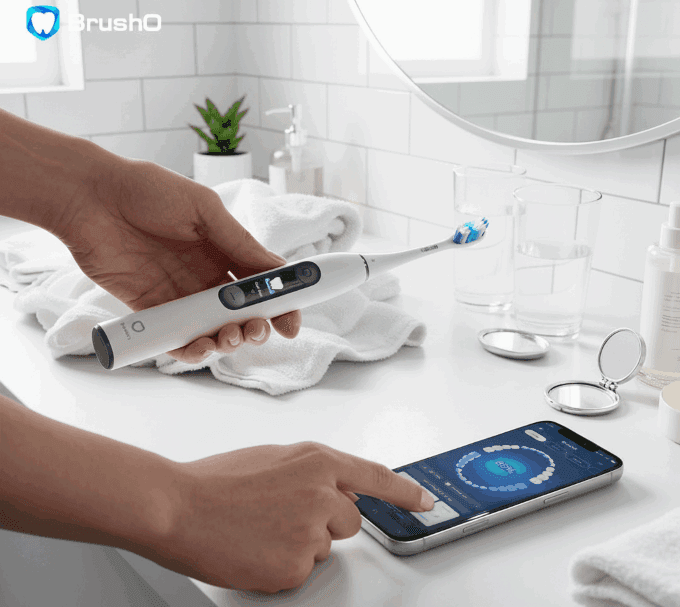
Smart brushing technologies such as BrushO enhance protection through:
• Pressure control protecting enamel
• Zone tracking eliminating bacterial buildup
• Habit analytics identifying risk patterns
• Adaptive brushing modes for sensitive conditions
These features compensate for reduced natural oral defenses.
Environmental factors are increasingly recognized as contributors to dental disease progression. Maintaining hydration, monitoring environmental exposure, and implementing intelligent brushing systems provide a comprehensive defense strategy against cavity development.
Sugar remains a well-known cavity trigger, but dry air undermines the biological systems that protect teeth daily. By reducing saliva effectiveness, altering bacterial dynamics, and weakening enamel repair mechanisms, low humidity environments create conditions that accelerate tooth decay. Adopting hydration awareness, consistent hygiene practices, and data-guided oral care solutions such as BrushO helps restore protective balance and maintain long-term dental resilience. Protecting your teeth isn’t just about limiting sugar — it’s about supporting the environment your mouth depends on to stay healthy.
Jul 30
Jul 30
Jul 29
Jul 22
Jul 19
Jul 17

The shift from metal-ceramic (PFM) to all-ceramic restorations represents one of the most significant material transitions in restorative dentistry over the past two decades. In the United States, all-ceramic crowns now account for over 65% of single-unit posterior restorations according to the 2023

For over a century, the dominant paradigm in caries management has been surgical: identify cavitated lesions, remove carious tissue with rotary instruments, and restore the tooth with a synthetic material. Silver diamine fluoride (SDF) — a colorless alkaline solution containing silver (25% w/v), flu

Regenerative endodontic procedures (REPs) represent a paradigm shift in the management of immature permanent teeth with necrotic pulps. For decades, the standard of care for these teeth — typically resulting from trauma or dens evaginatus in children and adolescents aged 7–16 years — was apexificati

The use of autologous blood-derived products to enhance wound healing and tissue regeneration has been a focus of surgical research for over four decades. The first-generation product, platelet-rich plasma (PRP), was introduced in the 1970s and gained popularity in the 1990s for its ability to deliv

These prevalence figures have significant clinical implications. A general dental practice with 500 implant patients can expect approximately 95 patients to develop peri-implantitis requiring intervention. Unlike periodontitis around natural teeth, peri-implantitis presents unique challenges: the ab

Dental implantology has undergone a fundamental shift in treatment philosophy over the past two decades. The original Branemark protocol, established in the 1970s, mandated extraction socket healing for 6 to 12 months before implant placement, followed by an additional 3 to 6 months of submerged hea

Esthetic dentistry has historically relied on analog diagnostic tools: mounted study casts on semi-adjustable articulators, two-dimensional facial photographs, manual wax-ups, and diagnostic mock-ups fabricated by the dentist or laboratory technician. While these methods have produced excellent resu

This article provides a comprehensive review of dental sleep medicine and OAT, covering diagnostic pathways, MAD appliance design categories, clinical efficacy benchmarks, side effect management, the critical role of physician-dentist collaboration, and the emerging role of digital workflows and rem

Dental radiography generates an enormous volume of diagnostic images annually: bitewings, periapicals, panoramic radiographs, and cone-beam computed tomography (CBCT) scans. In the United States alone, an estimated 500 million dental radiographs are taken each year, according to a 2023 analysis by t

Additive manufacturing has moved from the margins to the core of modern dentistry, reshaping how crowns, surgical guides, dentures, aligners, and models are produced. According to a 2023 market analysis by Grand View Research, the global dental 3D printing market was valued at $3.1 billion and is pr

Lo spazzolino elettrico BrushO con IA offre guida in tempo reale, feedback sulla pressione, monitoraggio della copertura e report di progresso nell’app per una routine quotidiana più pulita.
Lo spazzolino elettrico BrushO con IA offre guida in tempo reale, feedback sulla pressione, monitoraggio della copertura e report di progresso nell’app per una routine quotidiana più pulita.


Address: RM 1427, 14/F RADIO CITY 505, HENNESSY RD CAUSEWAY BAY, HONG KONG
Code: 000000
Phone: +852-53758652
Email: customerservice@brusho.com