
Jul 30
Jul 30
Jul 29
Jul 22
Jul 19
Jul 17
Most people don’t give much thought to where or how they store their toothbrush — but improper storage can lead to bacterial buildup, mold growth, and even decreased brush performance. In this article, we’ll explain the best ways to store your toothbrush to keep it clean, hygienic, and long-lasting. Plus, we’ll show how an AI-powered electric toothbrush like BrushO is designed to support proper storage and hygiene without extra effort.
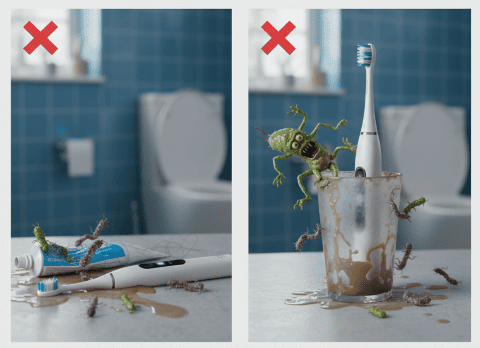
Most of us brush and rinse, then toss the brush back into a cup or bathroom counter without a second thought. But how you store your toothbrush can significantly affect your oral health. Toothbrushes can harbor harmful bacteria, especially when stored in moist, enclosed, or shared environments.
Poor storage habits can lead to:
Germ transmission
Mold or mildew growth
Premature wear of bristles
Contamination from nearby sinks or toilets
Here’s what dentists and experts recommend when it comes to daily storage:
Avoid keeping your toothbrush in drawers, sealed boxes, or dark cabinets. A toothbrush should be stored vertically in a well-ventilated holder to allow water to drip off and air to circulate. This prevents mold and bacterial growth.
Pro Tip: BrushO toothbrushes are designed with advanced water-resistant casing and quick-drying brush heads to support hygienic drying.
Toothbrushes should be stored at least 3 feet away from your toilet to prevent airborne particles (yes, the infamous “toilet plume”). Also, avoid placing it too close to the sink where dirty water might splash.
Make sure toothbrush heads don’t touch each other in multi-user households. Contact between bristles can transfer bacteria.
If you’re using BrushO’s replaceable brush head system, each family member can have their own personalized head, helping prevent cross-contamination.
A closed or airtight case may seem hygienic, but it actually traps moisture, encouraging bacteria. Choose open or vented holders.
Tip for Travelers: While BrushO doesn’t currently offer a travel case, you can use a breathable toothbrush sleeve or silicone cap with air vents.
Toothbrush holders often accumulate grime, toothpaste residue, and water stains. Clean it weekly with soap and hot water to prevent bacterial buildup.
Electric toothbrushes like BrushO often come with charging docks. Here’s how to store them safely:
Avoid laying the brush flat, which can trap water around the base. BrushO supports wireless QI charging, so storing it upright ensures efficient drying and charging.
Every few days, detach the head to let the internal grooves dry. BrushO’s snap-on design makes this effortless.
Wipe the base weekly with a dry cloth. If there’s buildup, use a slightly damp cloth but avoid soaking.
Proper storage prolongs life, but you still need to replace your brush head every 3 months, or sooner if the bristles are frayed. Dirty storage = faster wear.
✅ With BrushO’s lifetime free brush head program, users can redeem a new brush head regularly by brushing daily and earning points. It’s a smart incentive to keep both your brush and habits clean.
Taking a few extra seconds to store your toothbrush properly can protect your mouth from harmful bacteria and make your electric toothbrush last longer. With the help of innovative smart toothbrushes like BrushO, proper storage and hygiene are built into the product design.
By brushing smarter — and storing smarter — you’re one step closer to better oral health.
Jul 30
Jul 30
Jul 29
Jul 22
Jul 19
Jul 17

Saliva has moved from the byproduct of the examination to the fluid that the modern practice can read, and the diagnostics that the salivary sample supports now reach from the caries risk to the periodontal inflammation and beyond. The fluid is easy to collect, safe to handle, and rich in the pro...

The narrow alveolar ridge is the common obstacle that the implant plan meets in the healed posterior site, and the ridge split technique is the approach that widens the crest without the block graft and the second surgical site. The technique uses the viscoelastic property of the bone, and the co...

The resin-bonded bridge is the conservative alternative to the conventional fixed prosthesis, and its place in the modern practice has widened as the adhesive dentistry matured. The prosthesis replaces the missing tooth with the minimal removal of the enamel from the abutment, and the retention i...

The systemic antibiotic has a defined and a narrow place in the periodontal therapy, and the clinician who respects its limits uses it well while the clinician who reaches for it routinely erodes both the result and the antibiotic stewardship. The mechanical debridement remains the foundation of ...

The bond failure of the bracket is the interruption that the fixed orthodontic treatment can tolerate in the small number but not in the pattern, and the clinician who understands the cause reduces the frequency that the repeated rebonding records. The failure that recurs on the single tooth poin...

The prescription pad is one of the most common sources of the oral complaint that the patient brings to the dental office, and the clinician who does not think of the medication may spend the appointment treating the symptom that the drug created. The list of the agents that affect the mouth grow...

The intraoral scanner has moved from the novelty of the early adopters to the standard equipment of the modern prosthodontic practice, and the comparison with the conventional impression has become a daily question rather than an academic one. The scanner captures the surface of the teeth and the...

The endodontic retreatment is the second chance that the tooth receives when the initial treatment fails to resolve the infection or the symptoms, and the procedure is both more demanding and more rewarding than the primary treatment. The clinician who retreats the tooth encounters the filling ma...

The access preparation is the gateway of every root canal treatment, and it is the step at which the outcome of the case is most often decided, for good or for ill. A well-designed access straightens the canal system, removes the coronal obstruction, and allows the instruments and the irrigants t...

The restoration that the laboratory returns is only as good as the information that the clinician sends, and the communication between the dentist and the technician is the step that determines whether the crown, the veneer, or the bridge meets the expectation of the patient. The shade, the form,...

BrushO AI Electric Toothbrush offers real-time brushing guidance, pressure feedback, coverage tracking, and app-based progress reports for a cleaner daily routine.
BrushO AI Electric Toothbrush offers real-time brushing guidance, pressure feedback, coverage tracking, and app-based progress reports for a cleaner daily routine.


Address: RM 1427, 14/F RADIO CITY 505, HENNESSY RD CAUSEWAY BAY, HONG KONG
Code: 000000
Phone: +852-53758652
Email: customerservice@brusho.com