
Jul 30
Jul 30
Jul 29
Jul 22
Jul 19
Jul 17
What if brushing your teeth wasn’t just about staying healthy, but also about earning rewards? With BrushO, your daily brushing routine becomes more than hygiene—it becomes a habit that pays you back. Backed by smart AI and a built-in rewards ecosystem, BrushO turns a mundane task into a game-like experience where every brush earns you points, perks, and exclusive benefits. Whether you’re brushing for cleaner teeth, better habits, or real-world rewards, BrushO makes it all possible—automatically.
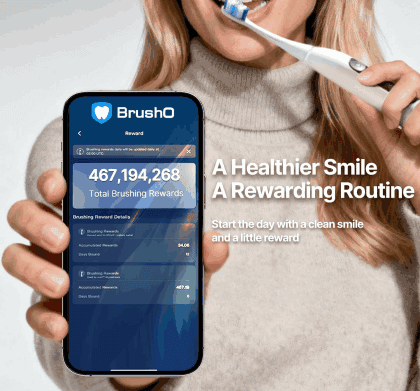
For most people, brushing is a routine chore with no feedback and no motivation to improve. Common issues include:
• Skipping brushes due to forgetfulness
• Brushing too quickly or too aggressively
• No sense of progress or reward
• Boring and repetitive routine
Without feedback or incentive, it’s easy to fall into bad habits. That’s where BrushO changes everything.
With BrushO’s “Brush & Earn” system, users get real-time benefits for consistent brushing. Here’s how it works:
Each brushing session is recorded via the BrushO app. You receive points based on:
• Brushing duration
• Coverage quality across 6 zones and 16 surfaces
• Pressure control
• Daily and weekly brushing consistency
Bonus: Consistent streaks and perfect brushing scores earn you extra points!
Once you accumulate enough points, you can redeem them for:
• Free replacement brush heads (for life!)
• Limited-edition accessories
• Discounts on future BrushO products
• Surprise gifts from brand partners
• Entry into exclusive challenges and raffles
Think of it as a loyalty program—except you’re getting rewarded for brushing your teeth.
The app acts as your personal brushing coach and reward tracker. It shows:
• Brushing scores and heatmaps
• Streak history
• Points earned and unlocked rewards
• Personal goals and brushing challenges
BrushO makes brushing feel like a game where you’re always improving—and winning.
Thousands of users report that BrushO has made them:
• More consistent with daily brushing
• More motivated to improve their technique
• Excited about checking their scores and rewards
• Engaged in their oral care like never before
The result? Not just healthier teeth and gums—but a sense of achievement.
Unlike generic reward apps or toothbrush subscriptions, BrushO ties real-time performance to real rewards. It doesn’t just count time—it analyzes how well you brush, guiding you to improve and rewarding you every step of the way. It’s the world’s first smart brushing ecosystem that turns good habits into real value.
With BrushO, you’re not just brushing—you’re building a healthier habit and earning while doing it. Every session becomes an opportunity to improve your technique, track your progress, and unlock real-world rewards.
🦷 Brushing better has never felt this good—or this rewarding.
BrushO is an AI-powered smart toothbrush that transforms daily brushing into a precision-guided, rewarding experience. With real-time feedback, personalized reports, habit tracking, and a built-in reward system, BrushO empowers users of all ages to brush better, smarter, and healthier—while earning rewards every day.
Jul 30
Jul 30
Jul 29
Jul 22
Jul 19
Jul 17

Hyperdontia is the presence of one or more teeth in excess of the normal dental formula, and the resulting teeth are described as supernumerary. The condition is common enough to appear in routine practice but variable enough in presentation that the decision to intervene is rarely straightforwar...

Few patients complete orthodontic treatment without asking whether their teeth will move back. The honest answer is that they will, to some degree, in the majority of cases. Relapse is not a failure of treatment but a predictable biological response, and understanding why it happens is the basis ...

The mandible is the largest and most frequently fractured bone of the facial skeleton, and its management sits at the interface between trauma surgery and restorative dentistry. Treatment has shifted over four decades from prolonged maxillomandibular fixation towards rigid internal fixation with ...

Chronic liver disease affects hundreds of millions of people worldwide, and its prevalence continues to rise with the epidemic of metabolic liver disease. The liver is central to haemostasis, drug metabolism and immune competence, and its failure therefore alters the risk profile of almost every ...

Excessive gingival display, commonly described as a gummy smile, is one of the most frequent aesthetic concerns presented to dental practitioners. The condition is not a single entity but a clinical presentation that can arise from skeletal, gingival, muscular or dental factors, and the treatment...

Drug-induced gingival overgrowth is a well-recognised adverse effect of several widely prescribed medications, and it remains one of the most common drug-related findings in periodontal practice. The condition produces firm, fibrous enlargement of the gingiva that can interfere with speech, masti...

Denture stomatitis is an inflammatory condition of the denture-bearing mucosa that affects a large proportion of removable prosthesis wearers, yet it is frequently dismissed as a cosmetic annoyance. The condition is driven by a Candida biofilm on the fitting surface of the prosthesis, and it is m...

Chronic kidney disease affects an estimated 850 million people worldwide, and the number of patients surviving on dialysis or with a renal transplant continues to rise. These patients carry an oral disease burden that is substantially higher than that of the general population, and their medical ...

Angular cheilitis is an inflammatory lesion of the labial commissures that presents with erythema, fissuring and crusting at the corners of the mouth. It is one of the most common conditions encountered in general dental practice, yet it is frequently treated as a simple fungal infection and allo...

Adverse reactions to dental materials are uncommon but they are not rare, and they are frequently misdiagnosed because the oral mucosa responds to allergens in a limited number of ways. A burning sensation, a persistent ulcer or an unexplained area of erythema may all represent a hypersensitivity...

BrushO AI ইলেকট্রিক টুথব্রাশ রিয়েল-টাইম ব্রাশিং গাইড, চাপের ফিডব্যাক, কভারেজ ট্র্যাকিং এবং অ্যাপ-ভিত্তিক অগ্রগতি রিপোর্ট দেয়, যাতে দৈনন্দিন রুটিন আরও পরিষ্কার ও সহজ হয়।
BrushO AI ইলেকট্রিক টুথব্রাশ রিয়েল-টাইম ব্রাশিং গাইড, চাপের ফিডব্যাক, কভারেজ ট্র্যাকিং এবং অ্যাপ-ভিত্তিক অগ্রগতি রিপোর্ট দেয়, যাতে দৈনন্দিন রুটিন আরও পরিষ্কার ও সহজ হয়।


Address: RM 1427, 14/F RADIO CITY 505, HENNESSY RD CAUSEWAY BAY, HONG KONG
Code: 000000
Phone: +852-53758652
Email: customerservice@brusho.com