
Jul 30
Jul 30
Jul 29
Jul 22
Jul 19
Jul 17
Yellow teeth can feel embarrassing, but they’re also incredibly common. The good news? There are safe, effective ways to brighten your smile—without damaging enamel or wasting money on gimmicks. In this article, we’ll explain what causes yellowing, what works (and what doesn’t), and how to adopt a daily oral care routine that actually delivers visible results. Plus, discover how BrushO helps you brush smarter for long-term whitening benefits.
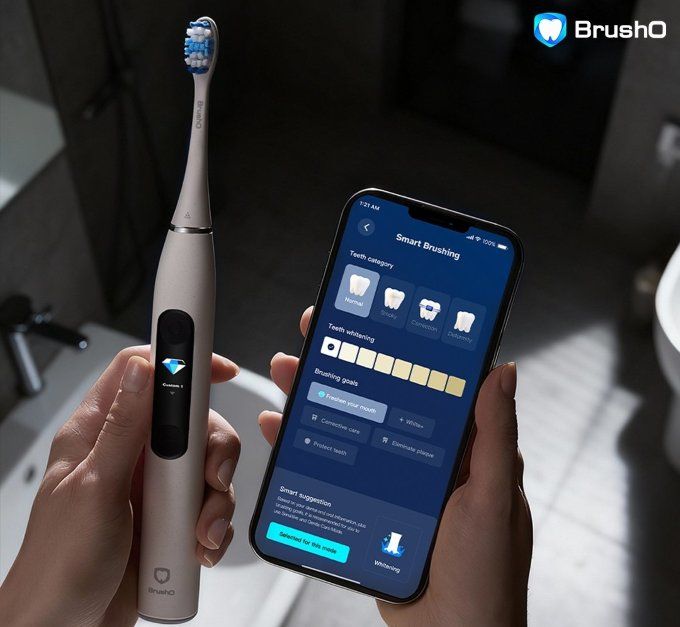
Understanding the cause helps you fix it. Common culprits include:
• Surface stains from coffee, tea, wine, and tobacco
• Plaque buildup from poor brushing technique
• Thinning enamel with age, revealing more of the yellow dentin
• Acidic foods that erode the tooth’s white surface
• Genetics—some people naturally have darker enamel tones
Here’s what dental experts recommend—and what BrushO supports through smarter brushing:
Dentist-supervised whitening treatments offer fast, dramatic results but may cause sensitivity. Ideal for short-term fixes.
Using a sonic smart toothbrush like BrushO removes more surface stains and prevents new ones from forming. Its real-time feedback ensures you brush all 16 surfaces evenly and gently.
Many whitening toothpastes are too abrasive. Opt for ADA-approved formulas, and pair with BrushO’s pressure sensors to avoid enamel damage.
Gentle abrasive, and pH-balancing. Use only once a week, and always with soft brushing to prevent scratching enamel.
Cut back on dark liquids like coffee, cola, and wine—or rinse with water afterward to minimize staining.
Don’t fall for internet myths. These methods may do more harm than good:
❌ Lemon juice or vinegar – Acidic and highly erosive to enamel
❌ Charcoal toothpaste – Too abrasive for daily use
❌ Overbrushing – Can damage enamel and expose dentin, making teeth appear more yellow
❌ Whitening too frequently – Leads to sensitivity and gum irritation
BrushO helps you avoid these pitfalls by tracking brushing pressure and frequency, and giving gentle guidance via its AI-powered app.
Create a sustainable whitening routine:
🦷 Brush twice daily with a smart toothbrush that ensures full coverage
💧 Floss once a day to prevent yellow plaque between teeth
🥤 Rinse after dark liquids or acidic foods
🪥 Replace brush heads regularly (BrushO provides lifetime free heads with point redemption!)
📊 Track your brushing to catch bad habits early
📱 Use a brushing app like BrushO’s to get real-time performance scores
BrushO isn’t just an electric toothbrush—it’s a whitening partner. Here’s how:
🎯 Smart sensors detect missed zones and uneven coverage
🧠 AI-driven app teaches gentle, consistent brushing technique
⚖️ Pressure alerts protect your enamel from overbrushing
🪄 Surface-level stain removal with optimal sonic frequency
💬 Progress tracking lets you monitor visible improvements over time
BrushO doesn’t promise overnight miracles—but it helps you build habits that lead to a naturally brighter smile.
There’s no magic fix for yellow teeth—but there is a smart one. By combining safe whitening methods with consistent brushing, smart tools, and daily mindfulness, you can gradually reveal a whiter, healthier smile that lasts.
BrushO is a next-gen AI-powered toothbrush built to improve oral health through intelligent zone tracking, real-time feedback, and habit reinforcement. With advanced pressure detection and a sleek, hygienic design, BrushO makes brushing not only smarter—but cleaner, gentler, and more effective.
Jul 30
Jul 30
Jul 29
Jul 22
Jul 19
Jul 17

Saliva has moved from the byproduct of the examination to the fluid that the modern practice can read, and the diagnostics that the salivary sample supports now reach from the caries risk to the periodontal inflammation and beyond. The fluid is easy to collect, safe to handle, and rich in the pro...

The narrow alveolar ridge is the common obstacle that the implant plan meets in the healed posterior site, and the ridge split technique is the approach that widens the crest without the block graft and the second surgical site. The technique uses the viscoelastic property of the bone, and the co...

The resin-bonded bridge is the conservative alternative to the conventional fixed prosthesis, and its place in the modern practice has widened as the adhesive dentistry matured. The prosthesis replaces the missing tooth with the minimal removal of the enamel from the abutment, and the retention i...

The systemic antibiotic has a defined and a narrow place in the periodontal therapy, and the clinician who respects its limits uses it well while the clinician who reaches for it routinely erodes both the result and the antibiotic stewardship. The mechanical debridement remains the foundation of ...

The bond failure of the bracket is the interruption that the fixed orthodontic treatment can tolerate in the small number but not in the pattern, and the clinician who understands the cause reduces the frequency that the repeated rebonding records. The failure that recurs on the single tooth poin...

The prescription pad is one of the most common sources of the oral complaint that the patient brings to the dental office, and the clinician who does not think of the medication may spend the appointment treating the symptom that the drug created. The list of the agents that affect the mouth grow...

The intraoral scanner has moved from the novelty of the early adopters to the standard equipment of the modern prosthodontic practice, and the comparison with the conventional impression has become a daily question rather than an academic one. The scanner captures the surface of the teeth and the...

The endodontic retreatment is the second chance that the tooth receives when the initial treatment fails to resolve the infection or the symptoms, and the procedure is both more demanding and more rewarding than the primary treatment. The clinician who retreats the tooth encounters the filling ma...

The access preparation is the gateway of every root canal treatment, and it is the step at which the outcome of the case is most often decided, for good or for ill. A well-designed access straightens the canal system, removes the coronal obstruction, and allows the instruments and the irrigants t...

The restoration that the laboratory returns is only as good as the information that the clinician sends, and the communication between the dentist and the technician is the step that determines whether the crown, the veneer, or the bridge meets the expectation of the patient. The shade, the form,...

BrushO AI ইলেকট্রিক টুথব্রাশ রিয়েল-টাইম ব্রাশিং গাইড, চাপের ফিডব্যাক, কভারেজ ট্র্যাকিং এবং অ্যাপ-ভিত্তিক অগ্রগতি রিপোর্ট দেয়, যাতে দৈনন্দিন রুটিন আরও পরিষ্কার ও সহজ হয়।
BrushO AI ইলেকট্রিক টুথব্রাশ রিয়েল-টাইম ব্রাশিং গাইড, চাপের ফিডব্যাক, কভারেজ ট্র্যাকিং এবং অ্যাপ-ভিত্তিক অগ্রগতি রিপোর্ট দেয়, যাতে দৈনন্দিন রুটিন আরও পরিষ্কার ও সহজ হয়।


Address: RM 1427, 14/F RADIO CITY 505, HENNESSY RD CAUSEWAY BAY, HONG KONG
Code: 000000
Phone: +852-53758652
Email: customerservice@brusho.com