
Jul 30
Jul 30
Jul 29
Jul 22
Jul 19
Jul 17
The human mouth hosts a dynamic microbial ecosystem known as oral biofilm — a structured community of bacteria attached to tooth surfaces and protected by extracellular matrices. Far from being static, this biofilm continuously adapts to daily hygiene habits, brushing techniques, dietary patterns, and saliva chemistry. Inconsistent or ineffective cleaning encourages resilient bacterial colonies that resist removal and increase disease risk. Conversely, structured, thorough brushing promotes healthier microbial balance and plaque stability. Understanding how oral biofilm responds to hygiene behavior helps individuals move beyond routine brushing toward precision biofilm management. This article explores the adaptive mechanisms of oral biofilm and how AI-guided brushing technologies help regulate microbial dynamics for long-term oral health.
Oral biofilm is often simplified as “plaque,” but biologically it is far more complex. It consists of:
• Multispecies bacterial communities
• Structural polysaccharide matrices
• Chemical signaling networks
• Surface adhesion mechanisms
These communities form organized layers that:
• Protect bacteria from mechanical disruption
• Resist antimicrobial exposure
• Coordinate growth through signaling molecules
Biofilm is therefore adaptive, not passive.
When brushing removes biofilm thoroughly and regularly:
• Harmful bacterial colonies struggle to stabilize
• Microbial diversity remains balanced
• Acid production decreases
• Inflammation risk is reduced
Healthy hygiene habits promote microbial equilibrium rather than eradication.
Biofilm adapts quickly to inconsistent removal:
• Matrix density increases
• Bacterial adhesion strengthens
• Acid-producing species dominate
• Resistance to remembering patterns form
This adaptation accelerates plaque buildup and enamel demineralization.
Excessive mechanical force can:
• Damage enamel surfaces
• Expose dentin microstructures
• Alter microbial attachment zones
Biofilm reorganizes around newly exposed textures, potentially increasing sensitivity-associated colonization.
Biofilm responds to predictable routines. If hygiene behavior shows:
• Skipped zones
• Short brushing duration
• Fixed brushing order
• Timing inconsistency
Microbial colonies adapt spatially and structurally, concentrating growth in neglected regions. This adaptive resilience explains why some individuals develop recurring localized dental problems.
Biofilm shifts in response to:
Frequent sugar exposure promotes:
• Acidogenic bacterial expansion
• Increased extracellular matrix formation
• Enamel erosion risk
Hydration and physiology affect:
• Buffering capacity
• Antimicrobial enzyme activity
• Biofilm stability
Acidic conditions select for:
• Acid-tolerant bacterial populations
• Faster enamel breakdown
• Reduced microbiome diversity
Hygiene habits interact directly with these environmental signals.
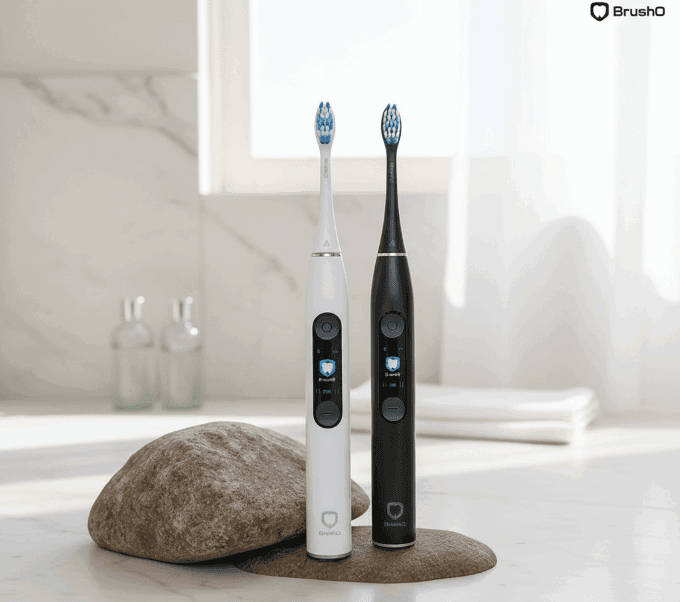
Advanced brushing systems such as BrushO introduce behavioral variability and precision control that disrupt biofilm adaptation.
AI zone monitoring ensures no surface becomes a stable bacterial reservoir.
Maintains effective removal without damaging enamel structures.
Reveals recurring cleaning gaps before biofilm adapts structurally.
Routine stabilization limits microbial dominance shifts.
Precision hygiene reduces the ecological advantages for harmful bacteria.
Managing biofilm adaptation helps:
• Lower cavity incidence
• Prevent gingival inflammation
• Maintain microbiome diversity
• Reduce tartar formation
• Stabilize enamel integrity
Oral health improves when the hygiene strategy evolves faster than microbial adaptation.
Oral biofilm is a responsive biological system shaped by daily hygiene behavior. Rather than simply accumulating, microbial communities reorganize and adapt to brushing consistency, technique, and environmental conditions. Understanding this dynamic interaction reframes oral hygiene as ecological management rather than routine cleaning. AI-guided brushing technologies support this approach by minimizing predictable gaps and improving coverage precision. By influencing how biofilm evolves, individuals gain proactive control over long-term oral health outcomes.
Feb 17
Feb 17
Jul 30
Jul 30
Jul 29
Jul 22
Jul 19
Jul 17

Hyperdontia is the presence of one or more teeth in excess of the normal dental formula, and the resulting teeth are described as supernumerary. The condition is common enough to appear in routine practice but variable enough in presentation that the decision to intervene is rarely straightforwar...

Few patients complete orthodontic treatment without asking whether their teeth will move back. The honest answer is that they will, to some degree, in the majority of cases. Relapse is not a failure of treatment but a predictable biological response, and understanding why it happens is the basis ...

The mandible is the largest and most frequently fractured bone of the facial skeleton, and its management sits at the interface between trauma surgery and restorative dentistry. Treatment has shifted over four decades from prolonged maxillomandibular fixation towards rigid internal fixation with ...

Chronic liver disease affects hundreds of millions of people worldwide, and its prevalence continues to rise with the epidemic of metabolic liver disease. The liver is central to haemostasis, drug metabolism and immune competence, and its failure therefore alters the risk profile of almost every ...

Excessive gingival display, commonly described as a gummy smile, is one of the most frequent aesthetic concerns presented to dental practitioners. The condition is not a single entity but a clinical presentation that can arise from skeletal, gingival, muscular or dental factors, and the treatment...

Drug-induced gingival overgrowth is a well-recognised adverse effect of several widely prescribed medications, and it remains one of the most common drug-related findings in periodontal practice. The condition produces firm, fibrous enlargement of the gingiva that can interfere with speech, masti...

Denture stomatitis is an inflammatory condition of the denture-bearing mucosa that affects a large proportion of removable prosthesis wearers, yet it is frequently dismissed as a cosmetic annoyance. The condition is driven by a Candida biofilm on the fitting surface of the prosthesis, and it is m...

Chronic kidney disease affects an estimated 850 million people worldwide, and the number of patients surviving on dialysis or with a renal transplant continues to rise. These patients carry an oral disease burden that is substantially higher than that of the general population, and their medical ...

Angular cheilitis is an inflammatory lesion of the labial commissures that presents with erythema, fissuring and crusting at the corners of the mouth. It is one of the most common conditions encountered in general dental practice, yet it is frequently treated as a simple fungal infection and allo...

Adverse reactions to dental materials are uncommon but they are not rare, and they are frequently misdiagnosed because the oral mucosa responds to allergens in a limited number of ways. A burning sensation, a persistent ulcer or an unexplained area of erythema may all represent a hypersensitivity...

BrushO AI Electric Toothbrush offers real-time brushing guidance, pressure feedback, coverage tracking, and app-based progress reports for a cleaner daily routine.
BrushO AI Electric Toothbrush offers real-time brushing guidance, pressure feedback, coverage tracking, and app-based progress reports for a cleaner daily routine.


Address: RM 1427, 14/F RADIO CITY 505, HENNESSY RD CAUSEWAY BAY, HONG KONG
Code: 000000
Phone: +852-53758652
Email: customerservice@brusho.com