
Jul 30
Jul 30
Jul 29
Jul 22
Jul 19
Jul 17
Brushing your teeth may feel like second nature—but staying consistent every single day? That’s where most of us fall short. BrushO changes that by turning your daily brushing into a habit worth celebrating. With its AI-powered tracking and a built-in points-based rewards system, BrushO motivates users to brush better, not just more often.
This blog takes you inside how the system works, why it’s so effective at helping people build long-term brushing habits, and how it aligns with BrushO’s larger mission: making oral care more rewarding, sustainable, and user-centric. Whether you’re a busy professional, a parent teaching your child to brush, or just someone who loves tech, BrushO’s approach has something valuable for you.
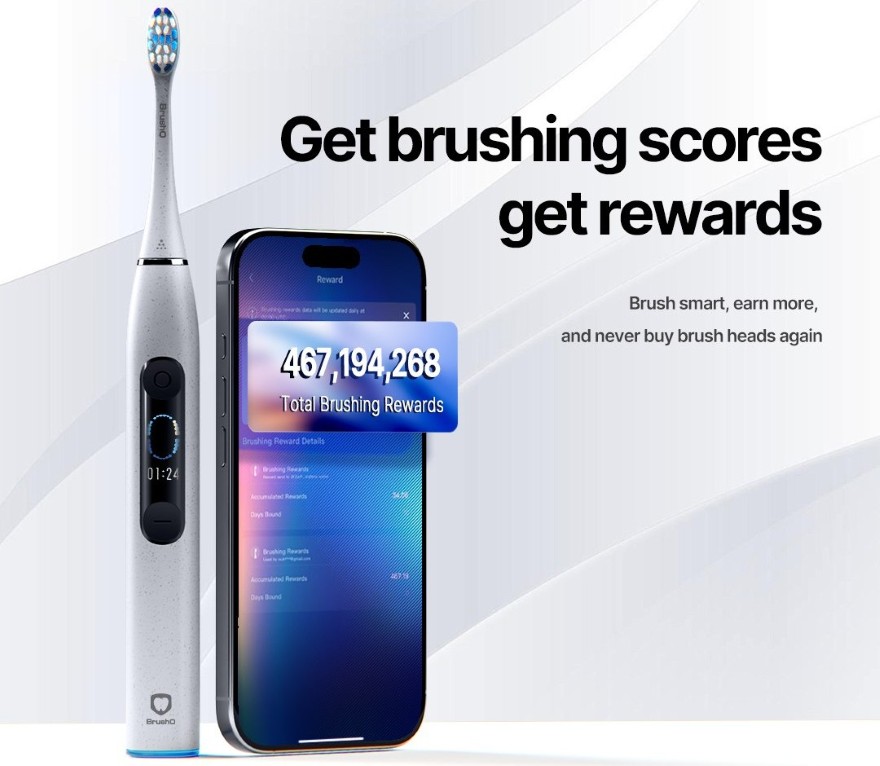
Let’s face it—brushing twice a day sounds easy in theory, but hard to maintain. BrushO understands that and flips the script by transforming brushing into something you look forward to. Its built-in rewards system turns your routine into a habit with real-world value.
Instead of guilt-based reminders or dentist lectures, BrushO offers positive reinforcement. Each time you brush correctly—with the right pressure, full coverage, and consistency—you earn points. These points go toward free brush head refills, helping you save money and reduce waste.
BrushO doesn’t penalize you for missing a day. Instead, it celebrates the effort you put in. Stick to brushing twice daily, and you’ll earn daily streak points. It’s a simple idea—brush regularly, collect rewards.
Using AI sensors and the companion app, BrushO tracks your:
• Brushing duration
• Surface coverage
• Brushing pressure
• Frequency & streaks
The data is shown in easy-to-read charts and reminders. Over time, this creates visible progress that keeps you motivated.
Once you reach a point threshold, you can redeem lifetime brush head refills—a core part of BrushO’s sustainable commitment. It eliminates the guesswork of when to replace your brush head and helps reduce plastic waste.
The reward system isn’t just for adults. Many parents report that children are more engaged in brushing when it becomes a “game.” By showing streaks and setting shared goals, BrushO helps families build oral care habits together.
There’s no competition—just small victories celebrated. Kids learn to view brushing as a daily routine, not a chore.
Behavioral psychology tells us: small rewards drive lasting change. That’s exactly what BrushO delivers. The app provides:
• Gentle reminders (instead of guilt)
• Encouraging messages when you hit a milestone
• Personalized brushing tips to help you improve
And when life gets hectic? BrushO simply helps you get back on track.
Beyond oral health, BrushO is on a mission to make dental care more sustainable and accessible:
• Lifetime brush head refills (through brushing points)
• No subscriptions required
• Web3-powered data ownership—you control your brushing records
• AI-guided feedback for smarter brushing
• Community support for progress sharing and dental advice
This is oral care built for the long term—not a one-time product, but a habit-building ecosystem.
BrushO is a smart electric toothbrush brand. Powered by adaptive AI and real-time coaching, it helps users improve brushing habits while earning rewards. Backed by 40+ UK dental clinics and introduced by Stanford, BrushO also offers a global vision—to make good habits valuable through its reward-based ecosystem.
Nov 4
Nov 4
Jul 30
Jul 30
Jul 29
Jul 22
Jul 19
Jul 17

Saliva has moved from the byproduct of the examination to the fluid that the modern practice can read, and the diagnostics that the salivary sample supports now reach from the caries risk to the periodontal inflammation and beyond. The fluid is easy to collect, safe to handle, and rich in the pro...

The narrow alveolar ridge is the common obstacle that the implant plan meets in the healed posterior site, and the ridge split technique is the approach that widens the crest without the block graft and the second surgical site. The technique uses the viscoelastic property of the bone, and the co...

The resin-bonded bridge is the conservative alternative to the conventional fixed prosthesis, and its place in the modern practice has widened as the adhesive dentistry matured. The prosthesis replaces the missing tooth with the minimal removal of the enamel from the abutment, and the retention i...

The systemic antibiotic has a defined and a narrow place in the periodontal therapy, and the clinician who respects its limits uses it well while the clinician who reaches for it routinely erodes both the result and the antibiotic stewardship. The mechanical debridement remains the foundation of ...

The bond failure of the bracket is the interruption that the fixed orthodontic treatment can tolerate in the small number but not in the pattern, and the clinician who understands the cause reduces the frequency that the repeated rebonding records. The failure that recurs on the single tooth poin...

The prescription pad is one of the most common sources of the oral complaint that the patient brings to the dental office, and the clinician who does not think of the medication may spend the appointment treating the symptom that the drug created. The list of the agents that affect the mouth grow...

The intraoral scanner has moved from the novelty of the early adopters to the standard equipment of the modern prosthodontic practice, and the comparison with the conventional impression has become a daily question rather than an academic one. The scanner captures the surface of the teeth and the...

The endodontic retreatment is the second chance that the tooth receives when the initial treatment fails to resolve the infection or the symptoms, and the procedure is both more demanding and more rewarding than the primary treatment. The clinician who retreats the tooth encounters the filling ma...

The access preparation is the gateway of every root canal treatment, and it is the step at which the outcome of the case is most often decided, for good or for ill. A well-designed access straightens the canal system, removes the coronal obstruction, and allows the instruments and the irrigants t...

The restoration that the laboratory returns is only as good as the information that the clinician sends, and the communication between the dentist and the technician is the step that determines whether the crown, the veneer, or the bridge meets the expectation of the patient. The shade, the form,...

BrushO AI Electric Toothbrush offers real-time brushing guidance, pressure feedback, coverage tracking, and app-based progress reports for a cleaner daily routine.
BrushO AI Electric Toothbrush offers real-time brushing guidance, pressure feedback, coverage tracking, and app-based progress reports for a cleaner daily routine.


Address: RM 1427, 14/F RADIO CITY 505, HENNESSY RD CAUSEWAY BAY, HONG KONG
Code: 000000
Phone: +852-53758652
Email: customerservice@brusho.com