
Jul 30
Jul 30
Jul 29
Jul 22
Jul 19
Jul 17
Think your toothbrush head can last a year? Think again. Using the same brush head for too long can seriously compromise your dental hygiene—and possibly your health. Worn bristles can’t clean properly, harbor bacteria, and may even damage your gums. In this article, we’ll explain why regular brush head replacement is essential, how often you really need to change it, and how BrushO’s free brush head program makes it easier than ever to stay protected and save money.
Over time, bristles lose their shape and stiffness, which reduces their ability to remove plaque and debris. A brush head that looks “fine” may have already lost 30%–40% of its cleaning effectiveness.
Old brush heads can become breeding grounds for millions of bacteria. The moist environment, combined with leftover toothpaste and mouth bacteria, creates the perfect space for microbial growth—even mold in some cases.
Frayed bristles not only clean less effectively, but they can also irritate your gums and wear down tooth enamel. If you’re brushing twice daily with a worn head, you might be hurting your teeth more than helping.
According to the American Dental Association (ADA), brush heads should be replaced every 3 months. You should also replace it sooner if:
The bristles look worn or splayed
You’ve recently been sick (e.g., flu, cold, strep throat)
The head has been dropped or exposed to contamination
🦷 Pro tip: With BrushO, your smart toothbrush reminds you when it’s time to replace the brush head—so you’ll never forget again.
Let’s be honest—it’s easy to forget. Most of us don’t mark a calendar or set reminders. Some assume that unless the bristles are obviously damaged, it’s fine. But even if your brush head looks okay, its microscopic wear can already be putting your teeth at risk.
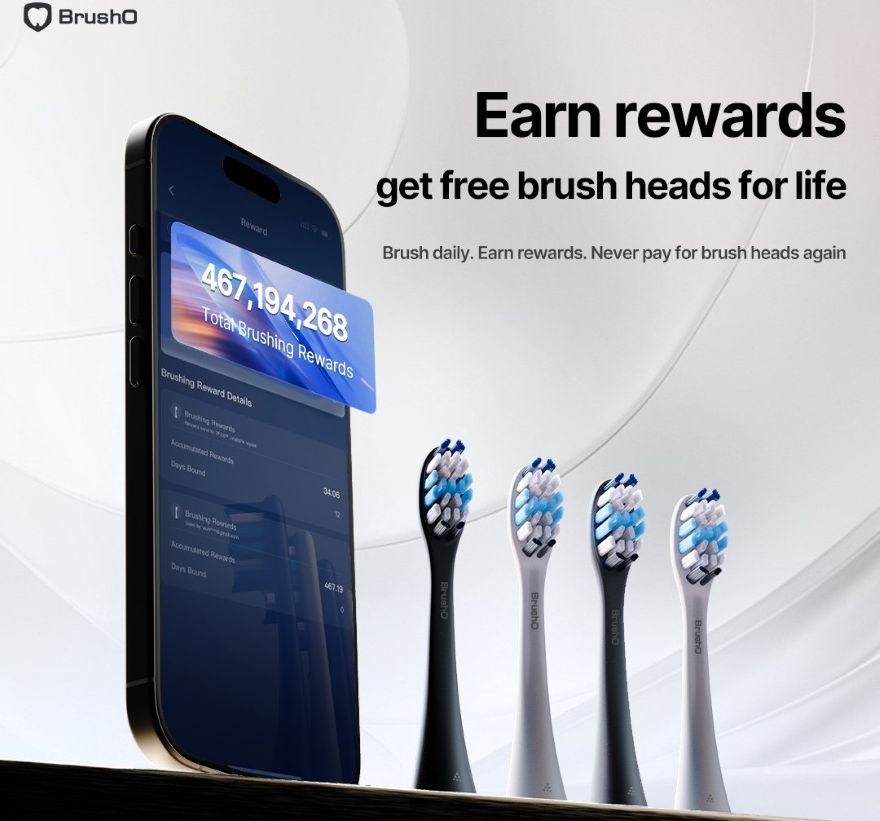
BrushO solves this problem with an industry-disrupting model: you get free brush heads for life.
Use BrushO to brush your teeth daily
Earn points for each brushing session via the BrushO app
Redeem points to claim free replacement brush heads
This means you’re rewarded for good habits—and never need to worry about overspending on essential care.
Fresh bristles remove bacteria and plaque more effectively, leading to fresher breath and less buildup.
New brush heads are gentle on the gumline and better at reducing inflammation and preventing gingivitis.
BrushO’s smart system syncs better with fresh bristles, giving you more accurate feedback and reports.
Bristles are frayed or bent
Discoloration (bristles turning yellow or gray)
Unusual smell or sticky residue
Your app alerts you (if using a smart brush like BrushO)
It’s been over 3 months
Replacing your toothbrush head isn’t just a hygiene tip—it’s a non-negotiable for good oral care. And with BrushO’s AI reminders and lifetime brush head plan, keeping your teeth protected has never been easier—or more affordable.
You’re not just brushing smarter—you’re brushing better, longer, and healthier.
Jul 30
Jul 30
Jul 29
Jul 22
Jul 19
Jul 17

The xerostomia is the symptom that the patient describes as the dry mouth, and the Sjogren syndrome is the systemic autoimmune condition that the clinician identifies as one of the causes that the symptom reveals. The dry mouth that the patient reports may follow the medication, the radiation, th...

The sinus lift is the augmentation procedure that the clinician performs to create the bone height that the posterior maxilla requires for the implant, and the choice between the lateral window and the transcrestal approach determines the surgical trauma, the healing, and the implant that the sit...

Post-extraction bleeding is one of the most common and most distressing experiences after a tooth extraction. For most patients, a small amount of oozing from the extraction site for 24 to 48 hours after the procedure is completely normal. However, when bleeding becomes excessive, prolonged, or d...

The skeletal class III malocclusion is the condition that the clinician treats with the orthognathic surgery or the camouflage orthodontic treatment, and the decision between the two paths determines the function, the aesthetics, and the stability that the patient receives. The orthognathic surge...

Interproximal enamel reduction — commonly referred to as IPR, slenderizing, stripping, or contouring — is the controlled removal of small amounts of enamel from the proximal surfaces of teeth. Despite sounding more invasive than it is, IPR is one of the most widely used and clinically safe proced...

The gingival graft is the surgical procedure that the periodontist performs to restore the keratinized tissue and to cover the exposed root, and the choice between the free gingival graft and the connective tissue graft determines the outcome that the patient receives. The free gingival graft har...

Denture adhesives — commonly known as fixatives or denture creams — are among the most widely used adjuncts in prosthodontic care. Millions of complete and partial denture wearers use some form of adhesive daily, often without a clear understanding of what these products do, when they should be u...

When a young patient presents with an immature tooth that has lost its vitality — typically due to trauma or deep caries — the endodontist faces one of the most consequential decisions in paediatric endodontics. The permanent root has not finished forming, the apex remains open, and the tooth is ...

The ankyloglossia is the condition that the lingual frenulum restricts the movement of the tongue, and the release of the frenulum in the infant is the procedure that the clinician performs to restore the function that the feeding and the speech require. The assessment that the clinician performs...

Dental amalgam fillings have been in clinical use since the mid-19th century, making them one of the most historically established restorative materials. In 2026, the conversation around amalgam replacement has shifted from a simple material preference debate to a nuanced clinical assessment of w...


Address: RM 1427, 14/F RADIO CITY 505, HENNESSY RD CAUSEWAY BAY, HONG KONG
Code: 000000
Phone: +852-53758652
Email: customerservice@brusho.com
