
Jul 30
Jul 30
Jul 29
Jul 22
Jul 19
Jul 17
Waking up with a dry, sticky mouth is not just uncomfortable — it is a warning sign that your oral environment is under attack. Nighttime dry mouth, also known as nocturnal xerostomia, dramatically increases the risk of cavities, gum disease, bad breath, and enamel erosion because saliva — your mouth’s natural defense system — slows down while you sleep. Simply drinking more water is not enough. True protection requires understanding the causes of dry mouth, managing saliva flow, protecting enamel, and using intelligent brushing tools like BrushO to reduce bacterial growth before bed. This article explains the science behind nighttime dry mouth and how to prevent long‑term damage with modern oral care strategies.
During sleep, your body naturally produces less saliva. Saliva is essential because it:
• Washes away food particles
• Neutralizes acids
• Controls harmful bacteria
• Repairs early enamel damage
When saliva drops, bacteria multiply rapidly. This creates an acidic environment that attacks enamel and irritates gums for 6–8 continuous hours.
• Faster cavity formation
• Gum inflammation and recession
• Thick tongue coating and bad breath
• Increased tooth sensitivity
• Higher risk of oral infections
Water cannot replace saliva’s protective role.
Drinking water only provides temporary moisture. It does not:
• Neutralize oral acids
• Control bacterial growth
• Restore enamel minerals
• Lubricate tissues for hours
Saliva contains enzymes, calcium, phosphate, and antibacterial proteins that water simply lacks. Once you fall asleep, water evaporates quickly, while bacteria keep producing acid all night.
• Bitter taste
• Coated tongue
• Sore gums
• Worse breath than before
Several factors contribute to nocturnal dry mouth:
Sleeping with an open mouth dries oral tissues and accelerates bacterial growth.
Antidepressants, antihistamines, blood pressure drugs, and sleep aids reduce saliva flow.
Low body hydration worsens saliva production.
Stomach acid entering the mouth irritates tissues and reduces saliva protection.
Stress hormones suppress saliva and weaken immune defense in the mouth.
Without saliva:
• Sugar stays on teeth longer
• Bacteria create more acid
• Enamel cannot repair itself
This leads to “sleep cavities” — decay that forms along the gumline and between teeth.
• Rapid enamel erosion
• New cavities despite brushing
• Gum bleeding and soreness
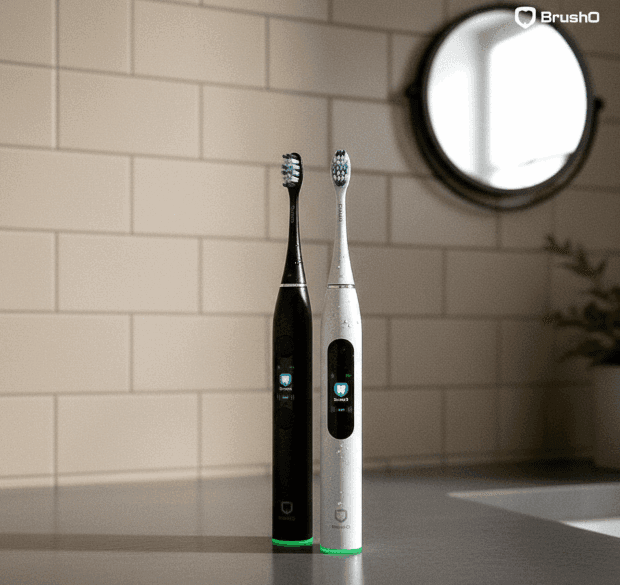
This is where BrushO makes a major difference. Night brushing is the most important brushing of the day. BrushO uses AI to ensure that your mouth enters the night with the lowest possible bacterial load.
• 6‑Zone × 16‑Surface tracking to remove plaque from every area
• Pressure sensors to protect weakened enamel
• Gum‑safe modes to prevent irritation
• App reports to reveal missed zones
• Habit reminders so nighttime brushing is never skipped
Reducing plaque before bed dramatically lowers overnight acid production.
1. Use BrushO before sleep for full‑mouth coverage
2. Floss to remove trapped bacteria
3. Use alcohol‑free fluoride rinse
4. Hydrate well before bed
5. Use a humidifier if you mouth‑breathe
6. Avoid sugar and acidic snacks at night
This creates a protective oral environment that lasts while you sleep.
Untreated dry mouth causes:
• Chronic gum disease
• Tooth loss
• Root decay
• Painful infections
• Expensive dental treatments
The earlier you manage it, the more enamel and gum tissue you save.
Nighttime dry mouth is not just discomfort — it is a serious risk factor for cavities, gum disease, and bad breath. Water alone cannot replace saliva’s protective power. The real solution is bacterial control, enamel protection, and smart brushing before bed. With BrushO’s AI‑powered guidance, you reduce the damage that dry mouth causes every night and protect your smile long‑term.
Feb 4
Jan 30
Jul 30
Jul 30
Jul 29
Jul 22
Jul 19
Jul 17

Hyperdontia is the presence of one or more teeth in excess of the normal dental formula, and the resulting teeth are described as supernumerary. The condition is common enough to appear in routine practice but variable enough in presentation that the decision to intervene is rarely straightforwar...

Few patients complete orthodontic treatment without asking whether their teeth will move back. The honest answer is that they will, to some degree, in the majority of cases. Relapse is not a failure of treatment but a predictable biological response, and understanding why it happens is the basis ...

The mandible is the largest and most frequently fractured bone of the facial skeleton, and its management sits at the interface between trauma surgery and restorative dentistry. Treatment has shifted over four decades from prolonged maxillomandibular fixation towards rigid internal fixation with ...

Chronic liver disease affects hundreds of millions of people worldwide, and its prevalence continues to rise with the epidemic of metabolic liver disease. The liver is central to haemostasis, drug metabolism and immune competence, and its failure therefore alters the risk profile of almost every ...

Excessive gingival display, commonly described as a gummy smile, is one of the most frequent aesthetic concerns presented to dental practitioners. The condition is not a single entity but a clinical presentation that can arise from skeletal, gingival, muscular or dental factors, and the treatment...

Drug-induced gingival overgrowth is a well-recognised adverse effect of several widely prescribed medications, and it remains one of the most common drug-related findings in periodontal practice. The condition produces firm, fibrous enlargement of the gingiva that can interfere with speech, masti...

Denture stomatitis is an inflammatory condition of the denture-bearing mucosa that affects a large proportion of removable prosthesis wearers, yet it is frequently dismissed as a cosmetic annoyance. The condition is driven by a Candida biofilm on the fitting surface of the prosthesis, and it is m...

Chronic kidney disease affects an estimated 850 million people worldwide, and the number of patients surviving on dialysis or with a renal transplant continues to rise. These patients carry an oral disease burden that is substantially higher than that of the general population, and their medical ...

Angular cheilitis is an inflammatory lesion of the labial commissures that presents with erythema, fissuring and crusting at the corners of the mouth. It is one of the most common conditions encountered in general dental practice, yet it is frequently treated as a simple fungal infection and allo...

Adverse reactions to dental materials are uncommon but they are not rare, and they are frequently misdiagnosed because the oral mucosa responds to allergens in a limited number of ways. A burning sensation, a persistent ulcer or an unexplained area of erythema may all represent a hypersensitivity...


Address: RM 1427, 14/F RADIO CITY 505, HENNESSY RD CAUSEWAY BAY, HONG KONG
Code: 000000
Phone: +852-53758652
Email: customerservice@brusho.com
