
Jul 30
Jul 30
Jul 29
Jul 22
Jul 19
Jul 17
Brushing your teeth once a day might feel “good enough” on a busy schedule — especially if you’re brushing at night and skipping the morning routine, or vice versa. But what really happens when you only brush once every 24 hours? This article explores the potential consequences, from plaque accumulation to enamel erosion, and explains why brushing twice a day — morning and night — is essential for optimal oral hygiene. With the help of smart toothbrushes like BrushO, it’s easier than ever to stick to this vital routine and ensure your teeth stay cleaner, healthier, and protected long-term.
Most dentists around the world recommend brushing at least twice a day — once in the morning and once before bed. This schedule aligns with how plaque and bacteria develop in the mouth.
• During the day, eating and drinking introduce sugars and acids that feed bacteria, which produce plaque.
• At night, while you sleep, your saliva production drops, making it easier for bacteria to grow and linger.
Skipping either session allows harmful bacteria to accumulate and damage your teeth and gums.
When plaque isn’t removed every 12 hours or so, it begins to harden into tartar (calculus), which can’t be brushed away with a normal toothbrush. This increases your risk of:
• Cavities
• Gum inflammation
• Bad breath
Brushing once a day means bacteria from your last meal may linger for 24 hours or longer, especially on the tongue and between teeth. This can result in chronic halitosis, or persistent bad breath.
The acids from leftover food particles and bacterial waste can erode your enamel over time, leading to tooth sensitivity and early decay — even if you brush well once daily.
Failing to clean the gumline thoroughly and regularly may lead to gingivitis (early gum disease). Inconsistent brushing allows plaque to build up at the base of teeth, triggering inflammation and bleeding.
Both are important, but skipping nighttime brushing is often worse because:
• Food particles remain in your mouth overnight
• Bacteria thrive in dry environments with no saliva flow
• You go 8+ hours with active bacteria undisturbed
Best practice: Never skip brushing before bed.
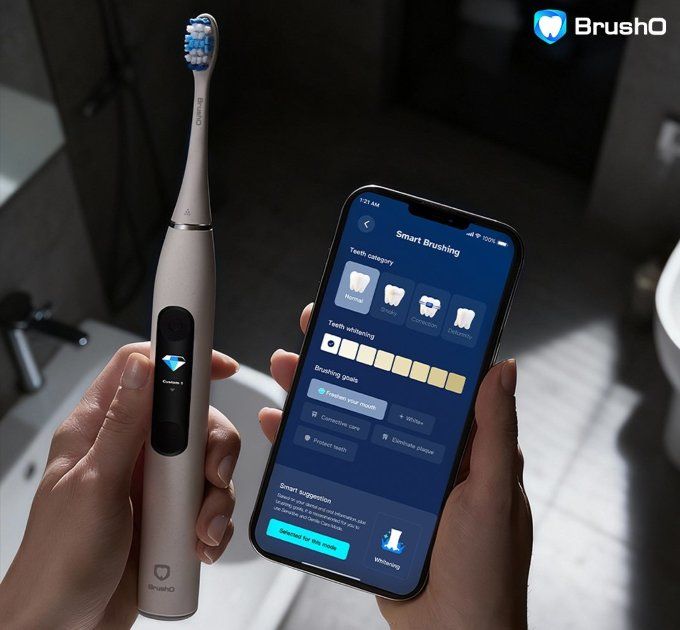
Developing consistency is the hardest part of brushing twice a day. That’s where BrushO comes in with features designed to support healthy daily habits:
The BrushO app reminds you to brush in the morning and evening — and tracks whether you actually do. This builds accountability and helps form habits.
Each brushing session is scored based on thoroughness, pressure, coverage, and timing. This gamified approach motivates users to complete both daily sessions.
BrushO’s family mode turns brushing into a fun challenge, especially for kids, rewarding consistent morning and night routines.
BrushO provides visual brushing maps to ensure all zones are cleaned — especially helpful for users who rush or miss areas when brushing only once a day.
Life happens. Missing one brushing session won’t destroy your oral health — but it shouldn’t become a habit. Make sure to:
• Floss to remove debris
• Rinse with mouthwash
• Resume your twice-a-day routine ASAP
Consistency over time is what really counts.
Brushing once a day is better than nothing, but it’s far from optimal. Over time, this habit may lead to enamel damage, cavities, and gum disease — all of which are preventable. With smart tools like BrushO, brushing twice a day becomes easier, smarter, and more effective — helping you protect not only your teeth, but your long-term health.
Dec 11
Dec 11
Jul 30
Jul 30
Jul 29
Jul 22
Jul 19
Jul 17

The posterior maxilla is the most demanding site in implant dentistry, because the pneumatized maxillary sinus frequently leaves the clinician with less bone than the implant requires. Maxillary sinus augmentation, the surgical procedure that raises the sinus floor to create vertical bone, has be...

The rubber dam is the oldest and still the most effective isolation device in restorative dentistry, and its reputation as an inconvenient extra step survives among practitioners who have never measured the time it actually saves. The dam isolates the field from the saliva, the tongue, and the ch...

The margin is the most vulnerable line in fixed prosthodontics, because it is the only boundary between the prepared tooth, the restoration, and the oral environment that the clinician cannot fully seal by effort alone. A restoration that fits seamlessly at the margin resists leakage, caries, and...

The masticatory system is built for function, yet much of its damage comes from habits that serve no purpose. Parafunctional habits, the clenching, the grinding, and the tongue pressing performed outside of normal function, sit behind much of the tooth wear, the temporomandibular pain, and the my...

Chronic mouth breathing in the growing child is seldom a dental problem in origin and almost always a facial one in consequence. The child who sleeps with the mouth open bypasses the physiologic benefits of nasal respiration, and the posture that the airway forces upon the tongue, the mandible, a...

The immediate denture is the prosthesis placed on the day the teeth are extracted, sparing the patient the edentulous interval the conventional denture imposes and preserving the occlusal vertical dimension, the facial support, and the appearance through the transition. The clinical literature ha...

The Class III malocclusion in the growing child carries a special urgency, because the maxillary deficiency that marks the pattern does not correct itself and the window for the growth-modifying treatment closes with the skeletal maturity. Elastic protraction, the orthopedic therapy that pulls th...

The denture is the only prosthetic device in medicine that its owner is expected to wear daily and to clean personally, yet it is also the device most commonly neglected until the signs of disease appear. A biofilm that forms on the acrylic base within hours is a reservoir of candida and bacteria...

The complete denture stands or falls on the impression, because the impression determines how well the base follows the mucous membrane and how evenly the occlusal load is distributed across the basal seat. For a century the profession has argued about whether the impression should record the muc...

The all-ceramic crown has moved from a niche product to the default restoration for the anterior single tooth in a single clinical generation, driven by patient demand for metal-free appearance and by materials that now survive functional loading as reliably as their metal-ceramic predecessors. A...


Address: RM 1427, 14/F RADIO CITY 505, HENNESSY RD CAUSEWAY BAY, HONG KONG
Code: 000000
Phone: +852-53758652
Email: customerservice@brusho.com
