
Jul 30
Jul 30
Jul 29
Jul 22
Jul 19
Jul 17
On a hot day, many people find it satisfying to crunch on leftover ice cubes from a drink. It feels refreshing, harmless — even hydrating. But is it really safe for your teeth? Dental professionals have long warned against the habit of chewing ice. Despite being calorie-free and seemingly “natural,” it can silently wreak havoc on your oral health in ways you may not notice until it’s too late.
Unlike chewing gum or soft foods, ice is hard, brittle, and unforgiving. Here’s how it impacts your teeth:
Enamel is the thin, hard outer surface of your teeth. Though it’s the strongest substance in your body, it’s not indestructible. Ice, with its solid and sharp edges, can gradually wear down enamel, leading to:
• Increased tooth sensitivity
• Higher risk of cavities
• Yellowish appearance as dentin becomes exposed
Chewing ice increases the risk of microfractures — small cracks that may:
• Lead to full-blown tooth fractures over time
• Worsen with hot/cold foods due to expansion and contraction
• Compromise the structure of dental fillings or crowns
Tip: If you’ve ever felt a sharp pain or odd crunch while chewing ice, you may have already chipped a tooth without realizing it.
Repeated stress from biting hard ice can cause:
• Gum inflammation from accidental scraping
• Jaw tension or TMJ issues in chronic ice chewers
Believe it or not, chewing ice can be a sign of an underlying issue.
A strong urge to chew ice (a condition known as pagophagia) is sometimes linked to iron deficiency anemia. If you find yourself craving ice frequently, consider consulting a healthcare provider.
For some, ice chewing becomes a stress-relieving behavior, similar to nail-biting. It offers oral stimulation but at the cost of your dental health.
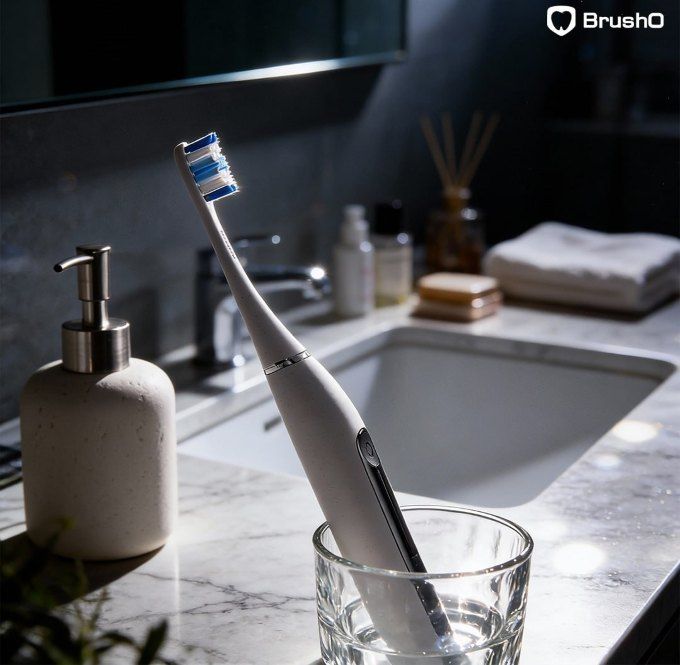
Even if you occasionally chew ice, you might not notice the long-term effects right away. That’s where smart tools like BrushO come in.
BrushO monitors brushing pressure and gives real-time feedback. If your enamel is compromised from habits like ice chewing, you’ll be guided to brush more gently and protect sensitive areas.
Heatmaps and brushing scores help highlight weak zones and gum sensitivity — clues that may relate to mechanical stress from ice chewing.
Over time, BrushO builds a profile of your brushing behavior, helping you identify and reverse risky patterns that could stem from or worsen ice damage.
If you’re struggling to kick the habit, try these alternatives:
• Chew sugar-free gum (stimulates saliva without harming enamel)
• Suck on ice chips instead of crunching
• Stay hydrated with chilled water or fruit-infused ice cubes
• Use soft oral chews for stress relief
What seems like a harmless habit can chip away — literally — at your dental health. From hidden enamel damage to increased risk of fractures, ice chewing is more dangerous than it looks. The good news? Awareness is the first step toward better habits. With BrushO, you can protect your teeth with real-time guidance, advanced feedback, and smarter brushing routines that adjust to your individual needs.
Let your toothbrush work smart — so you don’t have to worry about your next crunch.
Jul 30
Jul 30
Jul 29
Jul 22
Jul 19
Jul 17

Hyperdontia is the presence of one or more teeth in excess of the normal dental formula, and the resulting teeth are described as supernumerary. The condition is common enough to appear in routine practice but variable enough in presentation that the decision to intervene is rarely straightforwar...

Few patients complete orthodontic treatment without asking whether their teeth will move back. The honest answer is that they will, to some degree, in the majority of cases. Relapse is not a failure of treatment but a predictable biological response, and understanding why it happens is the basis ...

The mandible is the largest and most frequently fractured bone of the facial skeleton, and its management sits at the interface between trauma surgery and restorative dentistry. Treatment has shifted over four decades from prolonged maxillomandibular fixation towards rigid internal fixation with ...

Chronic liver disease affects hundreds of millions of people worldwide, and its prevalence continues to rise with the epidemic of metabolic liver disease. The liver is central to haemostasis, drug metabolism and immune competence, and its failure therefore alters the risk profile of almost every ...

Excessive gingival display, commonly described as a gummy smile, is one of the most frequent aesthetic concerns presented to dental practitioners. The condition is not a single entity but a clinical presentation that can arise from skeletal, gingival, muscular or dental factors, and the treatment...

Drug-induced gingival overgrowth is a well-recognised adverse effect of several widely prescribed medications, and it remains one of the most common drug-related findings in periodontal practice. The condition produces firm, fibrous enlargement of the gingiva that can interfere with speech, masti...

Denture stomatitis is an inflammatory condition of the denture-bearing mucosa that affects a large proportion of removable prosthesis wearers, yet it is frequently dismissed as a cosmetic annoyance. The condition is driven by a Candida biofilm on the fitting surface of the prosthesis, and it is m...

Chronic kidney disease affects an estimated 850 million people worldwide, and the number of patients surviving on dialysis or with a renal transplant continues to rise. These patients carry an oral disease burden that is substantially higher than that of the general population, and their medical ...

Angular cheilitis is an inflammatory lesion of the labial commissures that presents with erythema, fissuring and crusting at the corners of the mouth. It is one of the most common conditions encountered in general dental practice, yet it is frequently treated as a simple fungal infection and allo...

Adverse reactions to dental materials are uncommon but they are not rare, and they are frequently misdiagnosed because the oral mucosa responds to allergens in a limited number of ways. A burning sensation, a persistent ulcer or an unexplained area of erythema may all represent a hypersensitivity...

Электрическая зубная щетка BrushO с ИИ дает подсказки в реальном времени, обратную связь по давлению, отслеживание покрытия и отчеты о прогрессе в приложении для более чистой ежедневной рутины.
Электрическая зубная щетка BrushO с ИИ дает подсказки в реальном времени, обратную связь по давлению, отслеживание покрытия и отчеты о прогрессе в приложении для более чистой ежедневной рутины.


Address: RM 1427, 14/F RADIO CITY 505, HENNESSY RD CAUSEWAY BAY, HONG KONG
Code: 000000
Phone: +852-53758652
Email: customerservice@brusho.com