How Smart Toothbrushes Clean Every Surface of Your Teeth
Jan 21

Jan 21
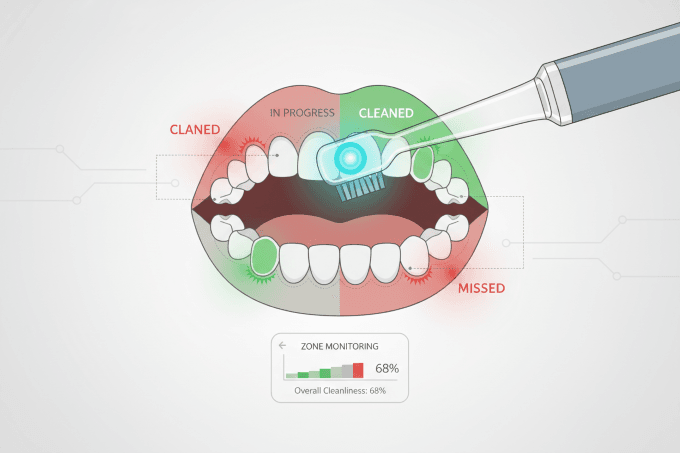
When brushing your teeth, ensuring every surface is thoroughly cleaned is crucial for maintaining optimal oral health. While traditional toothbrushes might leave certain areas missed, smart toothbrushes, equipped with sensors and AI, can track coverage and guide you to clean every surface effectively. In this article, we’ll explore how smart toothbrushes, like BrushO, clean each surface of your teeth, from front to back and every hard-to-reach corner. Discover how this advanced technology ensures you never miss a spot while brushing.


How Smart Toothbrushes Clean Every Surface of Your Teeth

1. The Challenge of Cleaning Every Surface of Your Teeth

To achieve optimal oral health, it’s crucial to clean all surfaces of your teeth—front, back, chewing surfaces, and even the areas along the gumline. However, with traditional manual or even basic electric toothbrushes, it's easy to miss certain areas, especially those at the back of the mouth or in between teeth.
Smart toothbrushes are designed to address this challenge. They are equipped with sensors and AI technology that track brushing coverage and ensure that every part of the mouth is cleaned thoroughly.

2. How Sensors Track Brushing Coverage

Smart toothbrushes use advanced motion sensors and accelerometers to track the movements of the toothbrush. These sensors map out the different zones of your mouth—often dividing the mouth into 6 zones, depending on the model. As you brush, the smart toothbrush monitors whether you’re covering all these areas effectively, ensuring that no part of your teeth is neglected.
The brushing process is monitored in real-time, and if you’re missing an area or brushing too quickly, the smart toothbrush will provide feedback through vibrations or visual indicators. This ensures that every surface, from the front of your teeth to the back molars, receives proper attention.

3. Brushing Technique: Covering All Surfaces Efficiently

Proper brushing technique is key to ensuring all tooth surfaces are cleaned effectively. Smart toothbrushes guide users in brushing at the correct angle and motion to ensure full-mouth coverage. Whether you’re using a circular or back-and-forth motion, the smart toothbrush’s AI system adapts to your style and gives personalized recommendations for better coverage.
For example, a smart toothbrush may suggest altering the angle for cleaning the gumline or adjusting pressure on the back molars. This targeted feedback improves the overall brushing technique and guarantees that no surface is left out.

4. The Importance of Brushing the Gumline and Hard-to-Reach Areas

The gumline and areas behind your teeth are often overlooked, especially when brushing manually. These areas are prone to plaque buildup and can contribute to gum disease if not cleaned properly. Smart toothbrushes are equipped with pressure sensors and coverage tracking features that alert you when you’re not brushing the gumline or other hard-to-reach areas thoroughly enough.
By ensuring proper cleaning of these often-neglected spots, smart toothbrushes help maintain healthier gums and reduce the risk of plaque and tartar buildup.

5. AI-Powered Feedback for Complete Coverage

AI technology in smart toothbrushes takes the guessing out of brushing. With AI-powered feedback, these devices track your brushing behavior over time, analyzing which areas of your mouth are getting the most attention and which areas are being missed.
By providing real-time guidance, smart toothbrushes help you improve your technique, making sure you cover all surfaces. These devices also keep track of your progress, offering insights and reminders that encourage better brushing habits.

6. Personalized Brushing Modes for Comprehensive Cleaning

Smart toothbrushes often come with different brushing modes tailored to specific needs, such as a "deep clean" mode, a "gum care" mode, or a "white+" mode. These modes optimize brushing for specific areas of your teeth and allow you to clean every surface more efficiently. For example, the deep clean mode may focus on areas that need extra attention, while the gum care mode targets the gumline.
These customizable modes, paired with AI-powered feedback, ensure that every surface of your teeth gets the attention it needs for optimal cleaning.

7. Progress Tracking and Continuous Improvement

The data collected by your smart toothbrush is stored and analyzed in the corresponding app, allowing you to track your progress over time. Weekly or monthly reports provide an overview of your brushing habits, highlighting areas that need improvement. If you’re consistently missing a certain surface or not brushing for the recommended duration, the app will remind you and offer tips for improvement.
By offering actionable feedback, smart toothbrushes help users develop better brushing habits and ensure that every surface of the teeth is cleaned effectively.

8. The Long-Term Benefits of Full Surface Cleaning

Cleaning all surfaces of your teeth is key to maintaining long-term oral health. Smart toothbrushes not only ensure that every surface is cleaned during each brushing session, but they also help you establish better brushing habits over time. Consistent use of a smart toothbrush can lead to healthier gums, reduced plaque buildup, and fewer cavities.
By preventing missed areas and ensuring proper coverage, smart toothbrushes promote long-term oral health and help you avoid common dental issues like gum disease and tooth decay.
 

Final Thoughts: Smart Toothbrushes for Thorough, Effective Cleaning

Smart toothbrushes take the guesswork out of brushing by providing real-time feedback and personalized recommendations. With advanced sensors and AI technology, these devices ensure that every surface of your teeth is cleaned thoroughly, from the front to the back and everywhere in between.
By using a smart toothbrush, you can ensure that your brushing habits are more effective, leading to healthier teeth, gums, and a brighter smile in the long run.

Последние записи

Ultrasonic Scaling and Root Surface Debridement

Ultrasonic Scaling and Root Surface Debridement

The removal of supra- and subgingival biofilm is the foundation of periodontal therapy, and the ultrasonic scaler has become the instrument of choice for much of this work. A mechanical tip vibrating at high frequency, energized by an oscillating water spray, disrupts the biofilm, chips away the ...

Teledentistry: Remote Consultation in Modern Dental Care

Teledentistry: Remote Consultation in Modern Dental Care

Teledentistry uses telecommunication technology to provide dental care at a distance, allowing the clinician to assess a patient, triage an emergency, plan a case, or monitor a course of treatment without a physical visit. The idea is not new, but the pandemic of 2020 accelerated its adoption and...

Remineralization of Enamel Lesions: Agents and Clinical Protocols

Remineralization of Enamel Lesions: Agents and Clinical Protocols

A white spot lesion is the earliest clinically visible stage of caries, a subsurface demineralization that still can be reversed if the environment of the mouth is changed. Remineralization restores mineral into the damaged enamel and is the treatment of choice before a lesion reaches the cavitat...

Photobiomodulation (Low-Level Laser Therapy) in Dentistry

Photobiomodulation (Low-Level Laser Therapy) in Dentistry

Photobiomodulation, once called low-level laser therapy, uses red or near-infrared light at doses that do not heat the tissue to modulate cellular activity and promote healing. In dentistry the therapy has moved from a curiosity to a documented adjunct for pain, inflammation, and wound recovery, ...

Periodontal Regeneration with Enamel Matrix Derivative

Periodontal Regeneration with Enamel Matrix Derivative

Repair of a periodontal defect closes the pocket but leaves a long junctional epithelium as a fragile scar, while true regeneration restores the cementum, periodontal ligament, and bone that the disease destroyed. Enamel matrix derivative, marketed as Emdogain, is a purified extract of developing...

Osseodensification: A Novel Approach to Implant Site Preparation

Osseodensification: A Novel Approach to Implant Site Preparation

Conventional implant site preparation removes bone with cutting drills that sacrifice the very tissue the implant relies on for stability. Osseodensification, introduced by Huwais and Meyer in 2017, reverses this logic by using a specially designed bur that compacts and densifies the bone walls o...

Implant Overdentures: Attachment Systems Compared

Implant Overdentures: Attachment Systems Compared

An implant overdenture is a removable prosthesis retained by two or more implants, and it converts the unstable conventional denture into a chewing platform that the patient trusts. Between the implant and the denture sits the attachment, the small mechanical or magnetic connector that holds the ...

Guided Biofilm Therapy: A Modern Approach to Dental Prophylaxis

Guided Biofilm Therapy: A Modern Approach to Dental Prophylaxis

The removal of biofilm is the oldest task in dentistry, yet conventional polishing with a rubber cup and paste still scrubs the surface, leaves the deep pockets untouched, and often produces a spray of aerosolized bacteria. Guided biofilm therapy changes this by first staining the biofilm so that...

Chemomechanical Caries Removal: Enzyme-Based Systems

Chemomechanical Caries Removal: Enzyme-Based Systems

Conventional caries excavation removes soft dentin with rotary burs and hand instruments, but it also removes sound tissue and often leaves the patient anxious and the clinician pressing with unnecessary force. Chemomechanical caries removal offers a gentler path: a chemical agent softens the inf...

Bell's Palsy: Orofacial Manifestations and Dental Considerations

Bell's Palsy: Orofacial Manifestations and Dental Considerations

Bell's palsy is an acute, usually unilateral paralysis of the facial nerve that is not caused by an identifiable tumor, trauma, or infection, and it presents to the dental team as a sudden inability to close the eye, smile, or raise the eyebrow on one side. Because the paralysis affects structure...