
Jul 30
Jul 30
Jul 29
Jul 22
Jul 19
Jul 17
Your bathroom may seem like the perfect place to store a toothbrush—but its warm, damp environment could be cutting your toothbrush’s life short without you realizing it. High humidity accelerates bacteria growth, weakens structural integrity, and shortens both manual and electric toothbrush performance. In this post, we explore how humidity affects the lifespan of your toothbrush, signs of moisture damage, and how BrushO’s waterproof design is built to resist these everyday threats.
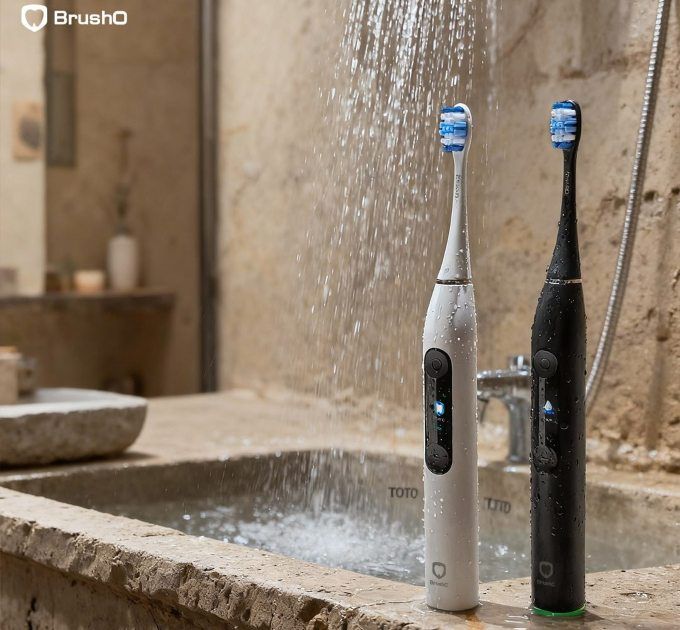
Bathrooms are one of the most humid spaces in any home. Daily showers create steam, condensation clings to surfaces, and airflow is often limited.
Toothbrushes stored near sinks, tubs, or in enclosed holders are frequently exposed to:
• Trapped moisture
• Warm, stagnant air
• Splash zones from faucets
This humidity doesn’t just cause mild discomfort—it can lead to bacterial growth, mildew, and long-term material breakdown.
Even simple manual brushes are vulnerable. Excess moisture can:
• Soften bristles prematurely
• Warp brush heads over time
• Promote mold growth at the base or in travel caps
• Cause musty odors from bacterial buildup
Most people keep their toothbrush in a cup or holder with no airflow, creating a breeding ground for germs that cling to your brush—even after rinsing.
Electric toothbrushes involve sensitive electronics, batteries, and motors. Humidity-related risks include:
• Corroded charging ports
• Short-circuited internal boards
• Sticky or unresponsive buttons
• Condensation under sealed screens
Over time, this moisture damage can degrade performance or cause complete failure—especially if the toothbrush isn’t IP-rated for waterproof use.
BrushO was engineered with real bathrooms in mind—not just ideal lab conditions. That’s why its design includes:
Sealed casing and no exposed screws protect internal electronics from steam, splashes, and moisture.
No metal prongs or corrosion-prone contacts.
Reduces buildup of moisture in the handle area for hygienic daily use.
BrushO’s packaging and travel kits include breathable features to prevent trapped moisture.
No matter what toothbrush you use, follow these simple steps to extend its life in a damp bathroom:
• Store upright in an open-air space
• Avoid closed containers or drawers
• Wipe electric toothbrush handles dry after each use
• Use a UV sanitizer or fast-drying stand if available
• Keep your brush away from steamy shower zones
• Replace brush heads every 3 months (or sooner if bristles fray or smell)
Your toothbrush works hard every day—but if humidity is quietly damaging it, you may not be getting the clean you think. Bacteria, mold, and electronic wear are all silent threats that can be prevented with smart storage and durable design. With BrushO, you don’t just get a smart toothbrush—you get peace of mind that your device can handle the real-world conditions of your bathroom.
BrushO is a next-generation AI-powered smart toothbrush that adapts to your brushing behavior with real-time feedback and zone scoring. Engineered with waterproof materials, ergonomic comfort, and smart charging, BrushO helps users build better oral care habits—even in humid, high-moisture environments.
Dec 17
Dec 17
Jul 30
Jul 30
Jul 29
Jul 22
Jul 19
Jul 17

The posterior maxilla is the most demanding site in implant dentistry, because the pneumatized maxillary sinus frequently leaves the clinician with less bone than the implant requires. Maxillary sinus augmentation, the surgical procedure that raises the sinus floor to create vertical bone, has be...

The rubber dam is the oldest and still the most effective isolation device in restorative dentistry, and its reputation as an inconvenient extra step survives among practitioners who have never measured the time it actually saves. The dam isolates the field from the saliva, the tongue, and the ch...

The margin is the most vulnerable line in fixed prosthodontics, because it is the only boundary between the prepared tooth, the restoration, and the oral environment that the clinician cannot fully seal by effort alone. A restoration that fits seamlessly at the margin resists leakage, caries, and...

The masticatory system is built for function, yet much of its damage comes from habits that serve no purpose. Parafunctional habits, the clenching, the grinding, and the tongue pressing performed outside of normal function, sit behind much of the tooth wear, the temporomandibular pain, and the my...

Chronic mouth breathing in the growing child is seldom a dental problem in origin and almost always a facial one in consequence. The child who sleeps with the mouth open bypasses the physiologic benefits of nasal respiration, and the posture that the airway forces upon the tongue, the mandible, a...

The immediate denture is the prosthesis placed on the day the teeth are extracted, sparing the patient the edentulous interval the conventional denture imposes and preserving the occlusal vertical dimension, the facial support, and the appearance through the transition. The clinical literature ha...

The Class III malocclusion in the growing child carries a special urgency, because the maxillary deficiency that marks the pattern does not correct itself and the window for the growth-modifying treatment closes with the skeletal maturity. Elastic protraction, the orthopedic therapy that pulls th...

The denture is the only prosthetic device in medicine that its owner is expected to wear daily and to clean personally, yet it is also the device most commonly neglected until the signs of disease appear. A biofilm that forms on the acrylic base within hours is a reservoir of candida and bacteria...

The complete denture stands or falls on the impression, because the impression determines how well the base follows the mucous membrane and how evenly the occlusal load is distributed across the basal seat. For a century the profession has argued about whether the impression should record the muc...

The all-ceramic crown has moved from a niche product to the default restoration for the anterior single tooth in a single clinical generation, driven by patient demand for metal-free appearance and by materials that now survive functional loading as reliably as their metal-ceramic predecessors. A...

Электрическая зубная щетка BrushO с ИИ дает подсказки в реальном времени, обратную связь по давлению, отслеживание покрытия и отчеты о прогрессе в приложении для более чистой ежедневной рутины.
Электрическая зубная щетка BrushO с ИИ дает подсказки в реальном времени, обратную связь по давлению, отслеживание покрытия и отчеты о прогрессе в приложении для более чистой ежедневной рутины.


Address: RM 1427, 14/F RADIO CITY 505, HENNESSY RD CAUSEWAY BAY, HONG KONG
Code: 000000
Phone: +852-53758652
Email: customerservice@brusho.com