
Jul 30
Jul 30
Jul 29
Jul 22
Jul 19
Jul 17
Many users ask: “Why does my toothbrush splash everywhere?” It’s one of the most common frustrations with electric toothbrushes. Water and toothpaste spray across mirrors and shirts, turning a simple habit into a messy chore. But it doesn’t have to be this way. In this article, we’ll explore why toothbrush splashing happens, the mistakes to avoid, and how BrushO’s FSB300 smart toothbrush—with its 64,000 RPM Maglev motor and auto-sensing anti-splash design—solves the problem.
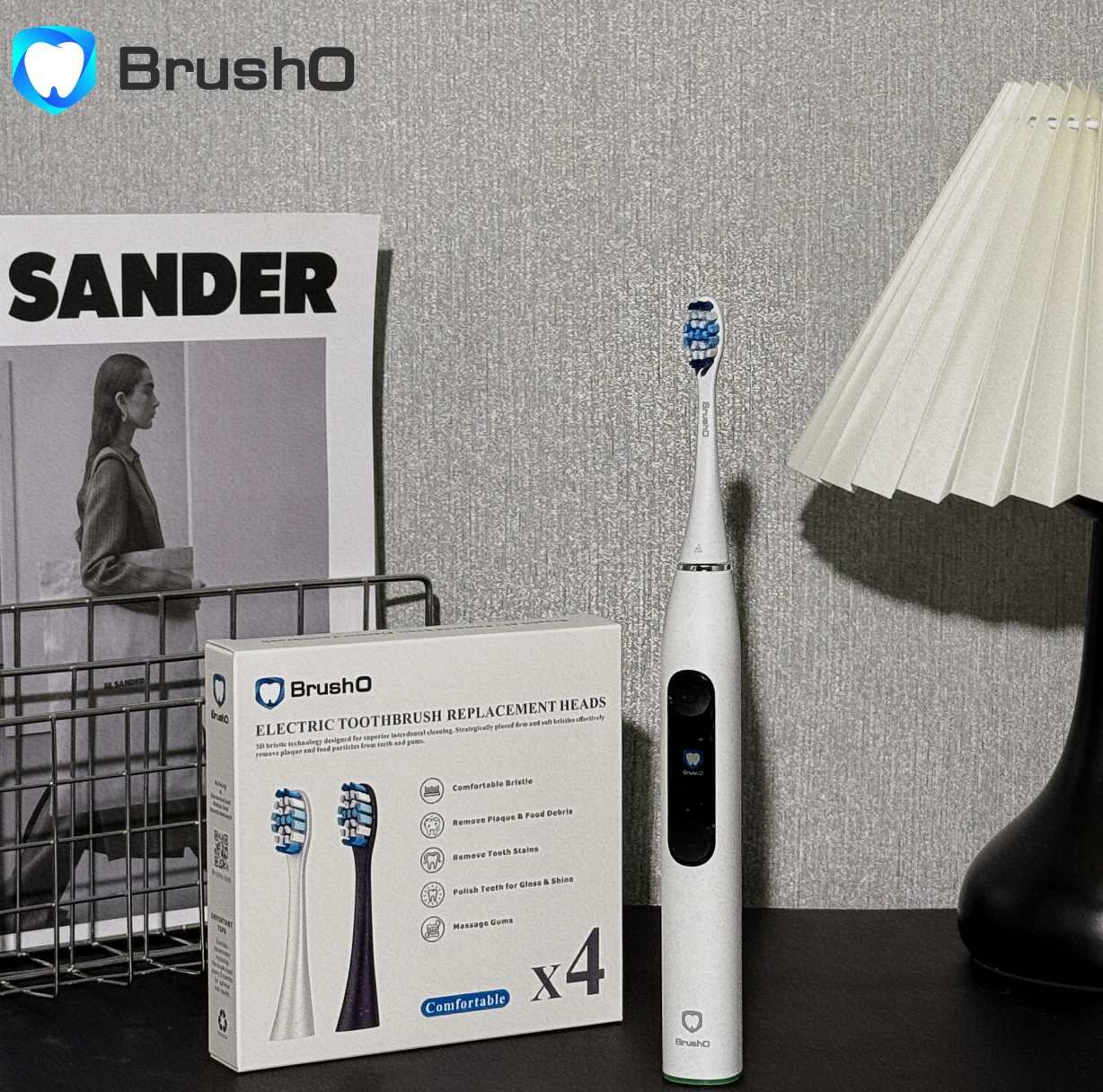
Turning it on too early: Switching on before the brush is in your mouth sprays foam everywhere.
Too much toothpaste: Excess foam escapes easily.
Open-mouth brushing: Foam flies out instead of staying contained.
Uncontrolled vibrations: Standard motors at 30K–40K RPM often produce uneven splatter.
👉 Splashes are not just about speed; it’s also about design and technique.
Powering On Before Brushing
Always place the brush in your mouth before pressing the start button.
Using Too Much Toothpaste
A pea-sized amount is enough. More = more foam = more splashes.
Brushing with Mouth Wide Open
Keep lips lightly closed to reduce spray.
Wrong Angle of Brushing
Pointing the brush outward instead of toward the gum line spreads the water.
Unlike many toothbrushes, BrushO’s FSB300 Smart Toothbrush is engineered to prevent splashes, even at ultra-high speeds.
64,000 RPM Maglev Motor ⚡
Despite one of the industry’s highest frequencies, BrushO uses linear magnetic suspension for smooth, controlled vibrations that don’t fling foam around.
Auto-Sensing Technology 🧠
The FSB300 detects pressure and brushing position, adapting vibration amplitude to minimize spray.
Optimized Brush Head Design 🪥
The brush head channels toothpaste and water directly onto teeth, not out of your mouth.
Smart Mode Selection 🔄
With sensitive and gum-care modes, users can choose gentler speeds that reduce mess without sacrificing cleaning.
Cleaner Bathroom: No more scrubbing toothpaste off mirrors.
Better Morning Routine: Quick brush before work without worrying about your shirt.
Kid-Friendly: Children can brush without making a mess.
Professional-Level Cleaning: High-frequency cleaning without the usual downsides.
Q1: Why does my toothbrush splash everywhere?
Because of excess foam, open-mouth brushing, or uncontrolled vibrations.
Q2: Can I stop splashing with a better technique?
Yes, use less toothpaste, close your lips, and power on after placing it in your mouth.
Q3: How does BrushO prevent splashing?
With a 64K RPM Maglev motor, auto-sensing technology, and optimized brush head design, it keeps brushing powerfully but clean.
Most electric toothbrushes splash because of poor design and user mistakes. But BrushO proves that powerful doesn’t have to mean messy. With its 64,000 RPM Maglev motor and auto-sensing anti-splash technology, BrushO FSB300 delivers a clean, efficient, and splash-free brushing experience every time.
Jul 30
Jul 30
Jul 29
Jul 22
Jul 19
Jul 17

Saliva has moved from the byproduct of the examination to the fluid that the modern practice can read, and the diagnostics that the salivary sample supports now reach from the caries risk to the periodontal inflammation and beyond. The fluid is easy to collect, safe to handle, and rich in the pro...

The narrow alveolar ridge is the common obstacle that the implant plan meets in the healed posterior site, and the ridge split technique is the approach that widens the crest without the block graft and the second surgical site. The technique uses the viscoelastic property of the bone, and the co...

The resin-bonded bridge is the conservative alternative to the conventional fixed prosthesis, and its place in the modern practice has widened as the adhesive dentistry matured. The prosthesis replaces the missing tooth with the minimal removal of the enamel from the abutment, and the retention i...

The systemic antibiotic has a defined and a narrow place in the periodontal therapy, and the clinician who respects its limits uses it well while the clinician who reaches for it routinely erodes both the result and the antibiotic stewardship. The mechanical debridement remains the foundation of ...

The bond failure of the bracket is the interruption that the fixed orthodontic treatment can tolerate in the small number but not in the pattern, and the clinician who understands the cause reduces the frequency that the repeated rebonding records. The failure that recurs on the single tooth poin...

The prescription pad is one of the most common sources of the oral complaint that the patient brings to the dental office, and the clinician who does not think of the medication may spend the appointment treating the symptom that the drug created. The list of the agents that affect the mouth grow...

The intraoral scanner has moved from the novelty of the early adopters to the standard equipment of the modern prosthodontic practice, and the comparison with the conventional impression has become a daily question rather than an academic one. The scanner captures the surface of the teeth and the...

The endodontic retreatment is the second chance that the tooth receives when the initial treatment fails to resolve the infection or the symptoms, and the procedure is both more demanding and more rewarding than the primary treatment. The clinician who retreats the tooth encounters the filling ma...

The access preparation is the gateway of every root canal treatment, and it is the step at which the outcome of the case is most often decided, for good or for ill. A well-designed access straightens the canal system, removes the coronal obstruction, and allows the instruments and the irrigants t...

The restoration that the laboratory returns is only as good as the information that the clinician sends, and the communication between the dentist and the technician is the step that determines whether the crown, the veneer, or the bridge meets the expectation of the patient. The shade, the form,...

A escova elétrica BrushO com IA oferece orientação em tempo real, feedback de pressão, rastreamento de cobertura e relatórios de progresso no app para uma rotina diária mais limpa.
A escova elétrica BrushO com IA oferece orientação em tempo real, feedback de pressão, rastreamento de cobertura e relatórios de progresso no app para uma rotina diária mais limpa.


Address: RM 1427, 14/F RADIO CITY 505, HENNESSY RD CAUSEWAY BAY, HONG KONG
Code: 000000
Phone: +852-53758652
Email: customerservice@brusho.com