
Jul 30
Jul 30
Jul 29
Jul 22
Jul 19
Jul 17
Many people believe they’re brushing their teeth properly—but molars are often left behind. As the most cavity-prone area, the back teeth require careful, consistent attention. BrushO’s smart toothbrush takes the guesswork out of brushing by detecting whether you’ve thoroughly cleaned your molars. With 6-zone, 16-surface tracking and real-time feedback, BrushO helps you ensure that even your hardest-to-reach teeth get the attention they deserve.
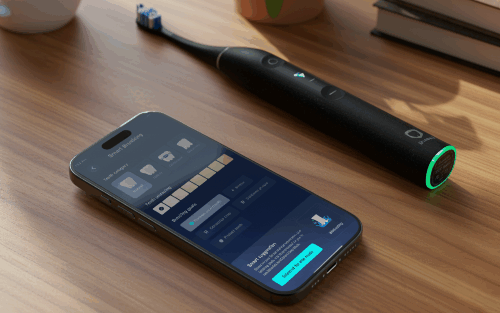
Your molars—the large teeth at the back of your mouth—play a crucial role in chewing and grinding food. But they’re also the most likely to accumulate plaque and food debris, simply because they’re harder to see and reach. Many people don’t brush long enough, use poor angles, or apply inconsistent pressure, especially at the back of the mouth.
Even with electric toothbrushes, without feedback or guidance, molars are often under-cleaned—leading to cavities, tartar, and even gum issues.
BrushO isn’t just another electric toothbrush—it’s a fully smart brushing assistant. With FSB technology and AI-powered zone tracking, it identifies how well each part of your mouth—including the molars—is cleaned.
Key ways BrushO improves molar brushing:
• 6 Zones, 16 Surfaces: Instead of the traditional 4-quadrant, 30-second timer approach, BrushO divides your mouth into 6 detailed zones and monitors 16 brushing surfaces.
• AI Feedback in Real Time: If you’re neglecting your molars, the LED ring will blink red, the handle display will indicate the issue, and the app will flag missed surfaces.
• Smart Reports & Scores: After each session, BrushO provides a brushing report showing if molars were cleaned thoroughly—no more brushing in the dark.
Neglected molars often develop:
• Cavities: Plaque buildup in molars is a leading cause of decay.
• Gum Disease: Inflammation often starts where brushing is poor—typically at the back.
• Bad Breath: Leftover debris in molars can lead to unpleasant odors.
• Costly Dental Bills: Fillings and cleanings are far more expensive than proper brushing.
By ensuring complete cleaning with BrushO, you’re preventing long-term issues before they start.
The BrushO App provides:
• Visual Molar Coverage Maps: See exactly where you missed.
• Brushing Habit Tracker: Track molar brushing consistency over weeks.
• Custom Suggestions: The AI offers suggestions based on your molar brushing habits.
• Brushprint Profiles: Get brushing styles tailored to your unique dental needs, including molar care.
Whether you’re teaching your child to brush correctly, helping a parent with mobility issues, or optimizing your own technique—BrushO makes brushing molars easier for:
• Children: Visual and audio feedback encourage fun brushing.
• Adults: Real-time alerts build smarter habits.
• Seniors: Ergonomic handle reduces the effort needed to reach back teeth.
BrushO encourages molar care while being eco-friendly:
• Rewards for Clean Molars: Earn points by brushing all areas—including the back teeth—and redeem them for lifetime brush head refills.
• Less Waste, Better Health: Clean teeth, cleaner planet.
If you’ve been skipping your molars—consciously or unconsciously—you’re not alone. But now, there’s a smarter way. BrushO helps ensure every tooth gets the attention it deserves, especially the ones that matter most: your molars. With zone tracking, instant feedback, and detailed reports, BrushO makes smart molar care simple, accurate, and part of your daily wellness ritual.
BrushO is a next-generation smart toothbrush brand integrating AI, ergonomic design, and sustainability. With features like FSB brushing intelligence, real-time feedback, habit tracking, and lifetime brush head rewards, BrushO turns daily brushing into a smarter, more effective experience. Recommended by over 40 dental clinics in the UK and backed by research from Stanford University.
Nov 17
Nov 17
Jul 30
Jul 30
Jul 29
Jul 22
Jul 19
Jul 17

The xerostomia is the symptom that the patient describes as the dry mouth, and the Sjogren syndrome is the systemic autoimmune condition that the clinician identifies as one of the causes that the symptom reveals. The dry mouth that the patient reports may follow the medication, the radiation, th...

The sinus lift is the augmentation procedure that the clinician performs to create the bone height that the posterior maxilla requires for the implant, and the choice between the lateral window and the transcrestal approach determines the surgical trauma, the healing, and the implant that the sit...

Post-extraction bleeding is one of the most common and most distressing experiences after a tooth extraction. For most patients, a small amount of oozing from the extraction site for 24 to 48 hours after the procedure is completely normal. However, when bleeding becomes excessive, prolonged, or d...

The skeletal class III malocclusion is the condition that the clinician treats with the orthognathic surgery or the camouflage orthodontic treatment, and the decision between the two paths determines the function, the aesthetics, and the stability that the patient receives. The orthognathic surge...

Interproximal enamel reduction — commonly referred to as IPR, slenderizing, stripping, or contouring — is the controlled removal of small amounts of enamel from the proximal surfaces of teeth. Despite sounding more invasive than it is, IPR is one of the most widely used and clinically safe proced...

The gingival graft is the surgical procedure that the periodontist performs to restore the keratinized tissue and to cover the exposed root, and the choice between the free gingival graft and the connective tissue graft determines the outcome that the patient receives. The free gingival graft har...

Denture adhesives — commonly known as fixatives or denture creams — are among the most widely used adjuncts in prosthodontic care. Millions of complete and partial denture wearers use some form of adhesive daily, often without a clear understanding of what these products do, when they should be u...

When a young patient presents with an immature tooth that has lost its vitality — typically due to trauma or deep caries — the endodontist faces one of the most consequential decisions in paediatric endodontics. The permanent root has not finished forming, the apex remains open, and the tooth is ...

The ankyloglossia is the condition that the lingual frenulum restricts the movement of the tongue, and the release of the frenulum in the infant is the procedure that the clinician performs to restore the function that the feeding and the speech require. The assessment that the clinician performs...

Dental amalgam fillings have been in clinical use since the mid-19th century, making them one of the most historically established restorative materials. In 2026, the conversation around amalgam replacement has shifted from a simple material preference debate to a nuanced clinical assessment of w...


Address: RM 1427, 14/F RADIO CITY 505, HENNESSY RD CAUSEWAY BAY, HONG KONG
Code: 000000
Phone: +852-53758652
Email: customerservice@brusho.com
