
Jul 30
Jul 30
Jul 29
Jul 22
Jul 19
Jul 17
Delaying a dental visit isn’t automatically harmful—but the safety margin depends on your risk profile, your daily plaque control, and whether silent problems are already developing. Cavities between teeth, early gum disease, enamel erosion, and bite-related wear often progress with little to no pain, which is exactly why routine checkups matter. A short delay may be reasonable if your gums are healthy, you have low cavity risk, and your home care is consistent and thorough. However, repeated postponement raises the odds that plaque turns into tartar, gum inflammation deepens below the gumline, and small areas of decay become larger (and more expensive) to treat. This guide explains what dental visits actually prevent, how long you can realistically stretch intervals, the warning signs that mean “do not delay,” and how data-driven brushing tools like BrushO can help you maintain a dentist-level standard of consistency between appointments.
A dental visit is not just a polish. It’s a screening and measurement checkpoint that home care can’t replicate. Dentists and hygienists can detect issues that are invisible or symptom-free early on, including:
• Interproximal cavities (between teeth) that you won’t see in the mirror
• Early gum disease developing under the gumline
• Enamel erosion from acids or reflux
• Bite and wear changes from clenching, grinding, or misalignment
• Tartar (calculus) deposits that brushing cannot remove once hardened
If you delay too long, these problems don’t pause—they simply become harder to treat.
A short delay may be relatively low risk (not “risk-free”) if most of these are true:
• You rarely get cavities and have no recent dental work
• Your gums don’t bleed when brushing or flossing
• You floss (or clean between teeth) consistently
• You don’t have frequent snacking/sugary drinks
• You don’t have chronic dry mouth, smoking/vaping habits, or untreated reflux
• You’re not currently experiencing sensitivity, pain, swelling, or persistent bad breath
In this situation, postponing a routine checkup by a few months is often less likely to cause sudden harm—but only if your daily plaque removal stays strong.
The main danger of delaying is that many dental problems are quiet at first.
Plaque left along the gumline can mineralize into tartar. Once tartar forms, it creates a rough surface that retains even more plaque and bacteria—raising the risk of gingivitis and, later, periodontal disease.
Decay often starts as microscopic demineralization. It may not hurt until it gets closer to the nerve, at which point treatment may shift from a simple filling to a deeper restoration.
Early gum inflammation can look mild, but the real issue may be under the gumline. Periodontal problems can advance with minimal discomfort until they become harder to reverse.
Grinding and clenching can flatten biting surfaces, trigger sensitivity, and stress restorations. Without checkups, wear patterns can go unnoticed until they cause pain or fractures.
Pain is a late signal in dentistry. Many conditions are painless until they’re advanced:
• early cavities
• early gum disease
• enamel erosion
• bite stress and wear
If you rely on pain as your indicator, you’re essentially waiting for the problem to become more complicated.
There isn’t one perfect schedule for everyone, but the core rule is simple: The higher your risk, the shorter your safe interval.
You’re more likely to need tighter intervals if you have:
• a history of cavities
• bleeding gums or past gum treatment
• orthodontic retainers/aligners
• dry mouth (mouth breathing, medications, dehydration)
• smoking or vaping habits
• reflux, frequent acidic drinks, or frequent snacking
• pregnancy or hormonal shifts that affect gums
• diabetes or immune-related conditions
If any of these apply, delaying routine visits tends to carry a bigger downside.
Do not “wait it out” if you notice any of the following:
• gums bleeding when brushing or flossing
• persistent bad breath that returns quickly
• sensitivity to cold, sweets, or brushing
• a dull ache or pressure that comes and goes
• swelling, a pimple-like bump, or bad taste near a tooth
• gum recession or teeth looking “longer”
• jaw pain, clicking, or frequent morning headaches
• rough deposits near the gumline that don’t brush off
These are often signs that something is already in motion.
If you want more flexibility between dental visits, your daily routine has to be consistently high quality, not just “twice a day.”
Focus on:
• gumline cleaning (where plaque triggers inflammation fastest)
• even coverage across back molars and inner surfaces
• gentle but effective pressure (too hard can worsen recession; too light leaves plaque)
• between-teeth cleaning (floss, interdental brushes, or water flosser)
The most common reason people get surprised at a checkup is predictable: they brush regularly—but miss the same zones every day.
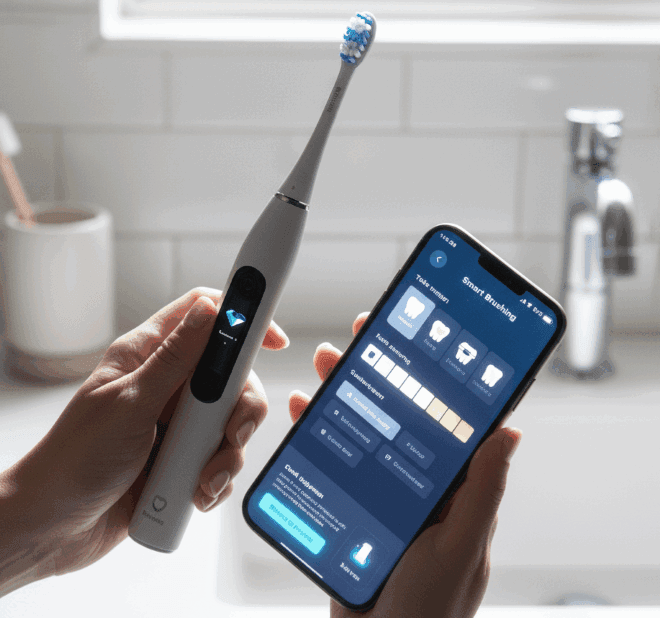
BrushO helps close the gap between “I brush daily” and “I brush effectively” by making the invisible parts measurable:
• coverage awareness so you don’t repeatedly miss the same spots
• pressure monitoring to protect gum tissue while still removing plaque
• habit reinforcement so consistency doesn’t collapse during busy weeks
• session feedback that turns brushing into a repeatable, high-standard routine
If you’re going to delay a visit, the best strategy is to make home care more precise, not merely more frequent.
You can sometimes delay a dental visit without immediate harm—but only if your cavity and gum risk are low and your daily plaque control is genuinely thorough. The bigger risk isn’t what you feel today; it’s what can progress quietly: tartar buildup, between-teeth decay, early gum disease, and enamel wear. If you’re postponing, treat your routine like prevention medicine—consistent, complete, and gumline-focused—with tools (like BrushO) that help you avoid the “same missed spots” pattern that leads to unpleasant surprises.
Feb 18
Feb 18
Jul 30
Jul 30
Jul 29
Jul 22
Jul 19
Jul 17

Hyperdontia is the presence of one or more teeth in excess of the normal dental formula, and the resulting teeth are described as supernumerary. The condition is common enough to appear in routine practice but variable enough in presentation that the decision to intervene is rarely straightforwar...

Few patients complete orthodontic treatment without asking whether their teeth will move back. The honest answer is that they will, to some degree, in the majority of cases. Relapse is not a failure of treatment but a predictable biological response, and understanding why it happens is the basis ...

The mandible is the largest and most frequently fractured bone of the facial skeleton, and its management sits at the interface between trauma surgery and restorative dentistry. Treatment has shifted over four decades from prolonged maxillomandibular fixation towards rigid internal fixation with ...

Chronic liver disease affects hundreds of millions of people worldwide, and its prevalence continues to rise with the epidemic of metabolic liver disease. The liver is central to haemostasis, drug metabolism and immune competence, and its failure therefore alters the risk profile of almost every ...

Excessive gingival display, commonly described as a gummy smile, is one of the most frequent aesthetic concerns presented to dental practitioners. The condition is not a single entity but a clinical presentation that can arise from skeletal, gingival, muscular or dental factors, and the treatment...

Drug-induced gingival overgrowth is a well-recognised adverse effect of several widely prescribed medications, and it remains one of the most common drug-related findings in periodontal practice. The condition produces firm, fibrous enlargement of the gingiva that can interfere with speech, masti...

Denture stomatitis is an inflammatory condition of the denture-bearing mucosa that affects a large proportion of removable prosthesis wearers, yet it is frequently dismissed as a cosmetic annoyance. The condition is driven by a Candida biofilm on the fitting surface of the prosthesis, and it is m...

Chronic kidney disease affects an estimated 850 million people worldwide, and the number of patients surviving on dialysis or with a renal transplant continues to rise. These patients carry an oral disease burden that is substantially higher than that of the general population, and their medical ...

Angular cheilitis is an inflammatory lesion of the labial commissures that presents with erythema, fissuring and crusting at the corners of the mouth. It is one of the most common conditions encountered in general dental practice, yet it is frequently treated as a simple fungal infection and allo...

Adverse reactions to dental materials are uncommon but they are not rare, and they are frequently misdiagnosed because the oral mucosa responds to allergens in a limited number of ways. A burning sensation, a persistent ulcer or an unexplained area of erythema may all represent a hypersensitivity...

BrushO AI電動歯ブラシは、リアルタイムのブラッシングガイド、圧力フィードバック、磨き残しの確認、アプリでの進捗レポートにより、毎日のケアをより清潔にサポートします。


Address: RM 1427, 14/F RADIO CITY 505, HENNESSY RD CAUSEWAY BAY, HONG KONG
Code: 000000
Phone: +852-53758652
Email: customerservice@brusho.com