
Jul 30
Jul 30
Jul 29
Jul 22
Jul 19
Jul 17
Traditional oral hygiene focuses on routine—brushing twice a day and flossing regularly. But what if your toothbrush could learn how you brush, correct your technique, and help you improve daily? This is the promise of AI-driven brushing feedback. By combining motion sensors, pressure mapping, and smart algorithms, brands like BrushO are transforming the act of brushing from guesswork into data-driven wellness.
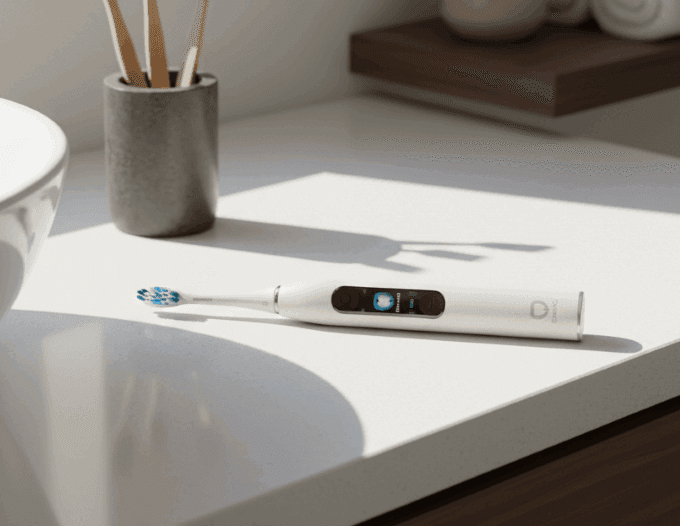
Most people believe they brush their teeth effectively. But research shows that:
• Over 70% of users miss certain zones while brushing
• Many apply too much or too little pressure
• Brushing duration is often shorter than the recommended 2 minutes
AI toothbrushes are designed to fix these gaps—not by brushing for you, but by training you to brush better through feedback and analytics.
AI toothbrushes use built-in gyroscopes and accelerometers to monitor your brushing pattern. They detect:
• Which zones of the mouth you’re brushing (e.g., upper right outer, lower inner left)
• How long you spend in each zone
• Whether you’re skipping areas or moving too fast
This data is mapped against ideal coverage patterns to guide users toward balanced cleaning.
Too much pressure can cause gum recession; too little leaves plaque behind. AI feedback systems use pressure sensors to:
• Instantly alert you (via LED or app) when brushing too hard
• Encourage gentler brushing techniques
• Help build long-term awareness of ideal pressure
BrushO’s FSB (Fully Smart Brushing) technology excels in this, offering nuanced feedback that protects both enamel and gums.
AI goes beyond passive data—it learns from your behavior and adapts. Over time, your smart toothbrush can:
• Adjust feedback intensity based on past brushing habits
• Identify trends (e.g., always missing your molars)
• Recommend changes, like switching to a “gum care” or “sensitivity” mode
This level of customization is what separates BrushO from basic electric toothbrushes.
With BrushO and similar smart systems, brushing isn’t just physical—it’s visual and educational. Your brushing session data is sent to the companion app, which includes:
• Coverage Maps: Heatmaps showing missed areas
• Pressure Graphs: A breakdown of the force applied during brushing
• Daily Scores: Motivation through brushing ratings and streaks
• Habit Tracking: Encouraging consistency through smart reminders and rewards
This data turns your toothbrush into an oral coach, helping you improve daily.
Data is useful, but only when it leads to better behavior. That’s why BrushO integrates feedback loops that:
• Reward improvement: Through streaks, scores, or even $BRUSH tokens
• Encourage mindful brushing: With guided timers and zone switching alerts
• Build routine: By linking brushing to habit cues (like app reminders or family leaderboards)
AI feedback becomes a behavioral nudge—small, frequent corrections that reinforce lifelong oral wellness.
While many AI toothbrushes offer similar features, BrushO stands out with:
• 6-Zone, 16-Surface Analysis: Covering every part of your mouth—not just top/bottom
• Dynamic Pressure Calibration: Adjusts feedback based on gum health and enamel sensitivity
• Web3 Integration: Earn $BRUSH tokens for consistent brushing performance
• Parental Monitoring: View your child’s brushing habits in real time via the app
• Lifetime Free Brush Heads: Rewarding long-term brushing consistency
AI-driven toothbrushes are more than gadgets—they’re powerful tools for preventive health. By turning every brushing session into a personalized lesson in technique, pressure, and consistency, smart feedback makes oral hygiene smarter, not harder. So if you’re serious about improving your smile—not just how it looks, but how healthy it is—it’s time to brush smarter with AI.
BrushO is a Stanford-introduced AI electric toothbrush that combines FSB sensor tech, real-time feedback, and app-based scoring to make brushing smarter and more rewarding. With features like zone guidance, pressure detection, and $BRUSH token rewards, BrushO helps you build habits that go beyond surface clean.
Jan 21
Jan 21
Jul 30
Jul 30
Jul 29
Jul 22
Jul 19
Jul 17

The xerostomia is the symptom that the patient describes as the dry mouth, and the Sjogren syndrome is the systemic autoimmune condition that the clinician identifies as one of the causes that the symptom reveals. The dry mouth that the patient reports may follow the medication, the radiation, th...

The sinus lift is the augmentation procedure that the clinician performs to create the bone height that the posterior maxilla requires for the implant, and the choice between the lateral window and the transcrestal approach determines the surgical trauma, the healing, and the implant that the sit...

Post-extraction bleeding is one of the most common and most distressing experiences after a tooth extraction. For most patients, a small amount of oozing from the extraction site for 24 to 48 hours after the procedure is completely normal. However, when bleeding becomes excessive, prolonged, or d...

The skeletal class III malocclusion is the condition that the clinician treats with the orthognathic surgery or the camouflage orthodontic treatment, and the decision between the two paths determines the function, the aesthetics, and the stability that the patient receives. The orthognathic surge...

Interproximal enamel reduction — commonly referred to as IPR, slenderizing, stripping, or contouring — is the controlled removal of small amounts of enamel from the proximal surfaces of teeth. Despite sounding more invasive than it is, IPR is one of the most widely used and clinically safe proced...

The gingival graft is the surgical procedure that the periodontist performs to restore the keratinized tissue and to cover the exposed root, and the choice between the free gingival graft and the connective tissue graft determines the outcome that the patient receives. The free gingival graft har...

Denture adhesives — commonly known as fixatives or denture creams — are among the most widely used adjuncts in prosthodontic care. Millions of complete and partial denture wearers use some form of adhesive daily, often without a clear understanding of what these products do, when they should be u...

When a young patient presents with an immature tooth that has lost its vitality — typically due to trauma or deep caries — the endodontist faces one of the most consequential decisions in paediatric endodontics. The permanent root has not finished forming, the apex remains open, and the tooth is ...

The ankyloglossia is the condition that the lingual frenulum restricts the movement of the tongue, and the release of the frenulum in the infant is the procedure that the clinician performs to restore the function that the feeding and the speech require. The assessment that the clinician performs...

Dental amalgam fillings have been in clinical use since the mid-19th century, making them one of the most historically established restorative materials. In 2026, the conversation around amalgam replacement has shifted from a simple material preference debate to a nuanced clinical assessment of w...

Lo spazzolino elettrico BrushO con IA offre guida in tempo reale, feedback sulla pressione, monitoraggio della copertura e report di progresso nell’app per una routine quotidiana più pulita.
Lo spazzolino elettrico BrushO con IA offre guida in tempo reale, feedback sulla pressione, monitoraggio della copertura e report di progresso nell’app per una routine quotidiana più pulita.


Address: RM 1427, 14/F RADIO CITY 505, HENNESSY RD CAUSEWAY BAY, HONG KONG
Code: 000000
Phone: +852-53758652
Email: customerservice@brusho.com