
Jul 30
Jul 30
Jul 29
Jul 22
Jul 19
Jul 17
Morning breath isn’t just unpleasant—it’s also surprisingly common. Almost everyone wakes up with it, even those with good oral hygiene. But what exactly causes your breath to go sour overnight, and is it something you can prevent entirely? Let’s uncover the real science behind morning breath—and how smart oral care tools like BrushO can help you tackle it at its root.
Your mouth is full of bacteria—both good and bad. During the day, saliva helps control these bacteria by constantly washing them away. But while you sleep, saliva production drops significantly, creating a dry environment. This dryness allows anaerobic bacteria (those that thrive in low-oxygen environments) to multiply, especially on the tongue and between teeth. These bacteria break down leftover food particles and dead cells, producing volatile sulfur compounds (VSCs)—the primary cause of that unpleasant morning odor.
Sleeping with your mouth open dries it out even more, creating a perfect breeding ground for odor-causing bacteria. This is especially common in people who:
• Snore or suffer from sleep apnea
• Have nasal congestion
• Use certain medications that cause dry mouth
If you eat sugary, acidic, or spicy foods before bed (without brushing afterward), you’re feeding oral bacteria overnight. Common culprits include:
• Alcohol
• Garlic and onions
• Sugary snacks
• Dairy products
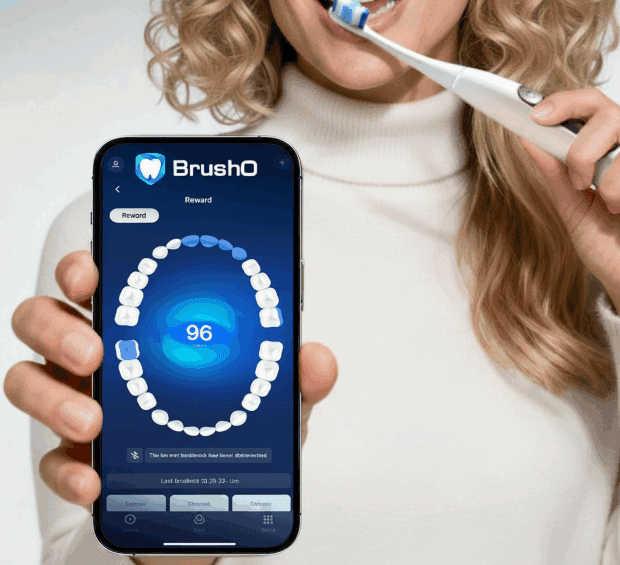
Brushing your teeth but skipping your tongue is one of the most common reasons for bad morning breath. The tongue’s surface can trap bacteria and dead cells. Using a smart toothbrush with tongue-cleaning guidance, like BrushO, ensures complete cleaning coverage before bed.
While morning breath is usually harmless, persistent bad breath throughout the day—known as chronic halitosis—could signal:
• Gum disease
• Tooth decay
• Tonsil stones
• Digestive issues
• Sinus infections
If brushing and flossing don’t fix the issue, consult your dentist or doctor.
Using an AI-powered toothbrush like BrushO ensures that you’re:
• Cleaning all 6 zones and 16 surfaces of your mouth
• Applying the right pressure
• Cleaning your tongue effectively
• Following your dentist’s recommended brushing time
This reduces the bacteria left behind overnight.
Brushing too early—even an hour before sleep—can leave your mouth vulnerable. Make sure it’s the last thing you do before sleep.
Drink water before bed and immediately after waking up. This helps stimulate saliva and wash away bacteria.
Don’t skip your tongue. Many smart toothbrushes (like BrushO) include tongue-cleaning reminders or built-in tongue care features.
Floss removes food particles from between teeth, and alcohol-free mouthwash can reduce bacteria while protecting the enamel.
BrushO’s AI technology goes beyond simple brushing:
• Smart coverage feedback: No zone is missed
• Pressure detection: Avoid enamel and gum damage
• Tongue-cleaning reminders: Keep your breath fresher
• Habit tracking & reports: See what you’re missing at night
• Reward system: Encourages better bedtime hygiene
It’s not just brushing—it’s a full oral care system that addresses the real causes of bad breath.
Morning breath is your body’s signal that bacteria took over while you slept. But with smart brushing tools, tongue care, hydration, and a solid nighttime routine, you can wake up feeling fresher, more confident, and ready to smile. BrushO is a Stanford-introduced, AI-powered smart toothbrush designed to elevate your brushing into a guided, habit-building experience. With real-time zone detection, enamel protection feedback, and integrated oral health reports, BrushO makes clean teeth and fresh breath effortless.
Jul 30
Jul 30
Jul 29
Jul 22
Jul 19
Jul 17

Teledentistry—the use of information and communication technologies to deliver dental care, consultation, education, and public health services across geographic distances—has undergone an unprecedented transformation in recent years. While the concept dates to the 1990s, the COVID-19 pandemic catal

The field of endodontics has undergone a paradigm shift over the past two decades. Traditional root canal therapy, while effective at eliminating infection and preserving teeth, ultimately results in a non-vital tooth that is more brittle and susceptible to fracture. Regenerative endodontics offers

The human oral cavity harbors one of the most diverse and dynamic microbial communities in the body, second only to the gut in complexity. Advances in culture-independent molecular techniques—particularly 16S rRNA gene sequencing and shotgun metagenomics—have transformed our understanding of the ora

Medication-related osteonecrosis of the jaw (MRONJ) is a serious adverse event characterized by exposed necrotic bone in the maxillofacial region that persists for more than eight weeks in patients with current or previous antiresorptive or antiangiogenic therapy and no history of head and neck radi

The dental patient population is aging, and the prevalence of chronic medical conditions continues to rise. The World Health Organization projects that by 2050, the proportion of the global population over 60 years will double from 12% to 22%, with a corresponding increase in the burden of multimorb

Saliva has emerged as a powerful diagnostic fluid that reflects the physiological and pathological state of the body. As an ultrafiltrate of blood, saliva contains a complex mixture of proteins, nucleic acids, metabolites, and microorganisms that originate from multiple sources: salivary glands, gin

Peri-implantitis has emerged as one of the most significant complications in implant dentistry, affecting an estimated 20% of patients and 10% of implants at the patient and implant levels respectively. As the global population of dental implants grows, the burden of peri-implant disease is expandin

Molar Incisor Hypomineralization (MIH) is a qualitative developmental enamel defect affecting one to four first permanent molars, frequently with concurrent involvement of permanent incisors. First described systematically by Weerheijm and colleagues in 2001, MIH has since been recognized as a globa

Digital Smile Design (DSD) has revolutionized aesthetic dentistry by providing a systematic, communication-centered approach to treatment planning. Developed by Dr. Christian Coachman in 2007, DSD integrates facial and dental analysis, intraoral and extraoral digital data, and interdisciplinary coll

Additive manufacturing, commonly known as 3D printing, has transformed dentistry over the past decade from a niche prototyping tool into an integral component of digital workflows. The technology enables the fabrication of surgical guides, dental models, temporary and permanent restorations, denture

BrushO AI इलेक्ट्रिक टूथब्रश रियल-टाइम ब्रशिंग गाइड, प्रेशर फीडबैक, कवरेज ट्रैकिंग और ऐप-आधारित प्रगति रिपोर्ट देता है, ताकि आपकी दैनिक दिनचर्या अधिक साफ और समझने योग्य बने।
BrushO AI इलेक्ट्रिक टूथब्रश रियल-टाइम ब्रशिंग गाइड, प्रेशर फीडबैक, कवरेज ट्रैकिंग और ऐप-आधारित प्रगति रिपोर्ट देता है, ताकि आपकी दैनिक दिनचर्या अधिक साफ और समझने योग्य बने।


Address: RM 1427, 14/F RADIO CITY 505, HENNESSY RD CAUSEWAY BAY, HONG KONG
Code: 000000
Phone: +852-53758652
Email: customerservice@brusho.com