
Jul 30
Jul 30
Jul 29
Jul 22
Jul 19
Jul 17
Tooth wear is often blamed on diet or brushing technique, but one of the most overlooked contributors is oral muscle tension. Chronic clenching, jaw tightness, and facial strain subtly increase bite pressure and friction across tooth surfaces, leading to accelerated enamel loss, sensitivity, and structural fatigue. Because these forces occur daily — often unconsciously — their impact accumulates over time. Understanding how muscular tension interacts with dental biomechanics allows individuals to adopt preventive strategies, refine brushing habits, and protect long-term oral stability. With modern AI-guided brushing tools such as BrushO, monitoring pressure and ensuring gentle, balanced cleaning further reduces compounding stress on already strained teeth.
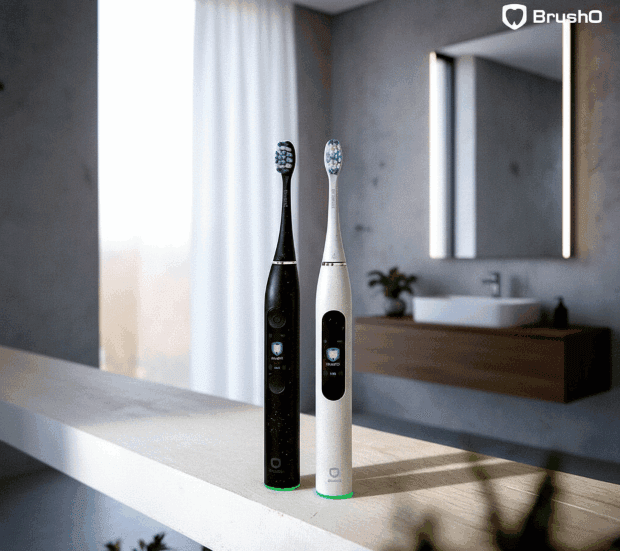
Tooth wear is a mechanical process influenced by friction, force, and repeated contact. While acidic beverages and aggressive brushing contribute, internal forces generated by oral muscles are equally significant.
The mouth contains powerful muscle groups responsible for:
• Chewing force generation
• Jaw stabilization
• Facial expression
• Swallowing coordination
These muscles can produce bite forces exceeding 70–150 pounds, and when tension becomes chronic, teeth experience sustained micro-loading that accelerates wear. This explains why individuals with seemingly healthy diets still develop enamel thinning or flattened cusps.
Common triggers include:
• Psychological stress or anxiety
• Night-time bruxism (grinding)
• Postural strain from screen use
• Jaw clenching during focus
• Poor breathing patterns
Many individuals are unaware that they maintain low-level tension throughout the day, creating constant pressure on tooth surfaces.
Muscle tension affects teeth through three main pathways:
Constant clenching raises contact intensity between upper and lower teeth, leading to:
• Surface flattening
• Micro-fractures in enamel
• Edge chipping
Grinding movements create lateral abrasion, wearing down protective enamel layers.
Stress-linked muscle tension often coincides with reduced salivary flow, weakening natural enamel protection and lubrication.
Because damage accumulates gradually, early warning signs are subtle:
• Teeth appearing shorter or flatter
• Increased sensitivity
• Jaw fatigue or soreness
• Hairline enamel cracks
• Headaches upon waking
Recognizing these indicators allows early behavioral adjustment before structural damage escalates.
Brushing cannot eliminate muscle tension, but improper brushing can amplify wear when enamel is already stressed.
High-risk brushing behaviors include:
• Applying excessive pressure
• Using abrasive motions
• Over-brushing frequency
• Uneven zone coverage
Smart brushing systems such as BrushO mitigate these risks by:
• Monitoring pressure levels
• Ensuring balanced coverage across 6 zones and 16 surfaces
• Providing technique feedback
• Supporting consistent, gentle brushing habits
Reducing brushing-induced friction prevents cumulative damage layered on top of muscle-related stress.
• Relax jaw posture when not chewing
• Avoid resting teeth together
• Maintain ergonomic posture during screen work
• Hydrate to support saliva function
• Night guards for grinding
• Stress management routines
• Personalized brushing analytics
• Routine dental monitoring
Combining muscular awareness with optimized brushing technique produces measurable long-term stability.
Modern preventive oral health focuses on behavioral biomechanics — understanding how daily actions shape long-term outcomes.
Tooth wear rarely stems from a single cause. Instead, it reflects:
• Mechanical stress
• Habit patterns
• Brushing dynamics
• Muscular tension
AI-powered brushing ecosystems like BrushO help transform oral care from a passive routine into measurable habit optimization, reducing compounding mechanical stress across years of daily use.
Oral muscle tension represents a silent but powerful force influencing tooth wear. Chronic clenching, grinding, and jaw strain generate pressure patterns that gradually reshape enamel and dental structure. While these forces cannot always be eliminated, awareness, behavioral adjustments, and intelligent brushing tools significantly reduce long-term impact. Protecting teeth is not only about cleaning them — it is about managing the forces acting on them every day.
Feb 10
Feb 9
Jul 30
Jul 30
Jul 29
Jul 22
Jul 19
Jul 17

Trigeminal neuralgia (TN), also known as tic douloureux, is a chronic orofacial pain disorder characterized by recurrent, unilateral, brief, electric shock-like pain in the distribution of one or more divisions of the trigeminal nerve. It is widely regarded as one of the most severe pain conditions

Tooth whitening has become one of the most sought-after elective dental procedures worldwide. With increasing emphasis on facial aesthetics, a bright, white smile is now widely perceived as a marker of health, youth, and social confidence. This article provides a comprehensive review of contemporary

The edentulous posterior maxilla presents unique challenges for implant rehabilitation due to the pneumatization of the maxillary sinus and the progressive resorption of the alveolar ridge following tooth loss. Sinus floor elevation, or sinus lift surgery, is a predictable and well-documented surgic

Photodynamic therapy (PDT) is a minimally invasive therapeutic modality that combines a photosensitizing agent, light of a specific wavelength, and molecular oxygen to produce cytotoxic reactive oxygen species. Originally developed for oncological applications, PDT has been increasingly adopted in d

The introduction of temporary anchorage devices (TADs) has fundamentally transformed orthodontic treatment by providing skeletal anchorage that is independent of patient compliance. TADs, also known as mini-implants or miniscrews, enable tooth movements that were previously impossible or required co

Dental caries remains one of the most prevalent chronic diseases worldwide, disproportionately affecting children, elderly populations, and communities with limited access to conventional restorative care. The traditional restorative approach requires expensive equipment, cooperative patients, and m

Platelet-rich fibrin (PRF), a second-generation platelet concentrate, has emerged as one of the most widely adopted autologous biomaterials in contemporary dentistry and oral surgery. Developed by Dr. Joseph Choukroun and colleagues in France in 2001, PRF represents a conceptual evolution from first

The transition from conventional to digital impressions represents one of the most significant technological shifts in contemporary dentistry. Intraoral scanners (IOS) have evolved from experimental prototypes in the 1980s to sophisticated clinical instruments that now rival and, in several key metr

Gingival recession, defined as the apical migration of the gingival margin beyond the cementoenamel junction with exposure of the root surface, is a prevalent condition affecting a substantial proportion of the adult population. Epidemiological studies report that approximately 50% of adults exhibit

Cone beam computed tomography (CBCT) has revolutionized endodontic diagnosis and treatment planning by providing three-dimensional imaging that overcomes the inherent limitations of conventional periapical radiography. While two-dimensional radiographs remain the first-line imaging modality for endo

BrushO AI इलेक्ट्रिक टूथब्रश रियल-टाइम ब्रशिंग गाइड, प्रेशर फीडबैक, कवरेज ट्रैकिंग और ऐप-आधारित प्रगति रिपोर्ट देता है, ताकि आपकी दैनिक दिनचर्या अधिक साफ और समझने योग्य बने।
BrushO AI इलेक्ट्रिक टूथब्रश रियल-टाइम ब्रशिंग गाइड, प्रेशर फीडबैक, कवरेज ट्रैकिंग और ऐप-आधारित प्रगति रिपोर्ट देता है, ताकि आपकी दैनिक दिनचर्या अधिक साफ और समझने योग्य बने।


Address: RM 1427, 14/F RADIO CITY 505, HENNESSY RD CAUSEWAY BAY, HONG KONG
Code: 000000
Phone: +852-53758652
Email: customerservice@brusho.com