
Jul 30
Jul 30
Jul 29
Jul 22
Jul 19
Jul 17
Smart sonic toothbrushes, like BrushO’s smart toothbrush, use high-frequency vibrations to deliver deep cleaning that reaches areas manual brushes often miss. This enhances plaque removal, gum health, and long-term oral wellness. Combining sonic tech with AI guidance, pressure sensors, and personalized brushing modes ensures comprehensive cleaning, better oral hygiene habits, and reduced risk of dental issues.
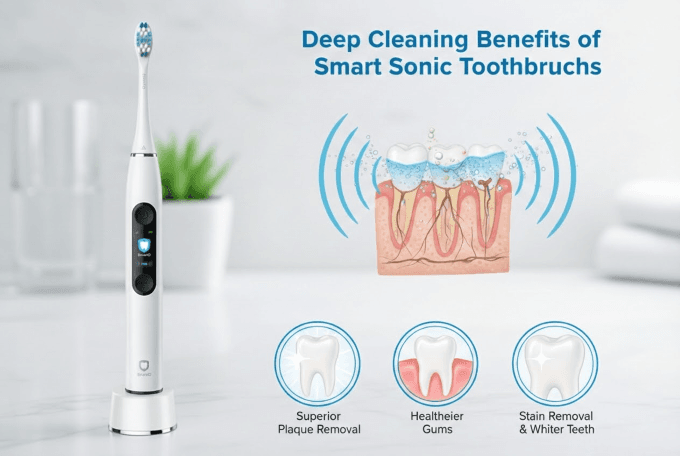
Many people assume all toothbrushes work the same—but when it comes to achieving a deep clean, smart sonic toothbrushes stand leagues ahead of manual brushing alone. Instead of merely relying on manual motion, sonic brushes harness high-frequency vibrations that create dynamic fluid movements, helping to dislodge plaque and bacteria even where bristles barely reach. Smart sonic toothbrushes—such as those from BrushO—combine this advanced cleaning power with intelligent guidance and feedback systems, giving users a smarter, more effective way to protect oral health. This article explores how sonic technology enhances deep cleaning and why it’s transforming modern oral care.
Sonic toothbrushes operate at tens of thousands of vibrations per minute, creating dynamic fluid action that extends cleaning far beyond the bristle tips. These vibrations generate microcurrents and microbubbles that penetrate between teeth and along the gumline, areas where manual brushes often miss. This mechanism disrupts bacterial plaque more effectively than normal brushing motion, leading to deeper removal of plaque and debris—especially in tight interdental spaces that are prone to decay and gum inflammation.
Unlike manual or simple electric toothbrushes, sonic toothbrush technology utilizes hydrodynamic cleaning—moving fluid within the mouth using high-speed motion. This fluid motion helps dislodge plaque and bacteria from areas where bristles cannot physically reach, such as under the gumline and between crowded teeth. This deeper reach not only improves overall cleanliness but also helps reduce the risk of gingivitis, periodontal issues, and tartar buildup when used consistently.
BrushO’s smart toothbrush pairs sonic cleaning power with AI-powered feedback to ensure you’re brushing effectively, not just vigorously. The built-in sensors analyze your brushing pattern and alert you when you need to adjust pressure, reach under-cleaned zones, or improve coverage. This real-time coaching helps users avoid common brushing mistakes—like missing inner surfaces or brushing too hard—and reinforces effective habits that contribute to deeper, more comprehensive oral hygiene.
Smart sonic toothbrushes offer specialized brushing modes—such as Deep Clean, Gum Care, and Whiten+—that tailor cleaning intensity to your specific needs. According to dental advice, matching brushing mode to oral condition helps maximize cleaning benefits without harming sensitive areas. This adaptability ensures that users can achieve a deep clean while still protecting enamel and gum tissue—something a manual brush cannot consistently provide.
A major downside of manual brushing is that many users inadvertently skip or under-clean certain sections of their mouth. Smart sonic toothbrushes track brushing effectiveness across zones to ensure consistent coverage, reducing the chance that plaque or bacteria remain hidden in neglected regions. By highlighting missed zones and providing interactive guidance, these devices help users achieve a deep, full-mouth clean every time.
Clinical research has shown that sonic toothbrushes remove significantly more plaque than traditional manual brushing. This enhanced plaque control is crucial because plaque buildup is the root cause of cavities, gum disease, and bad breath. By disrupting plaque biofilms and reducing bacterial load, sonic toothbrushes help lower the risk of periodontal concerns and support healthier teeth over time.
The fluid dynamics created by high-frequency sonic vibrations not only clean surfaces but also gently massage the gumline, supporting circulation and reducing inflammation. Studies have demonstrated that users of sonic brushes often show improvements in gingival health and reduced bleeding compared to manual brushing. This makes deep cleaning especially important for individuals prone to gum sensitivity or early signs of gum disease.
Individuals with braces, implants, or crowns benefit particularly from sonic toothbrushes. The high-frequency vibrations can reach around brackets, wires, and dental hardware more effectively than manual brushing alone, reducing the likelihood of plaque buildup in these difficult areas. This helps maintain oral hygiene around restorative work and orthodontics, protecting overall dental health.
Deep cleaning powered by sonic technology promotes confidence and consistency. When users see the tangible results of thorough brushing—such as improved gum health and cleaner teeth—they are more likely to maintain a disciplined oral care routine. Smart tracking and feedback further reinforce this beneficial cycle.
Deep cleaning with a smart sonic toothbrush combines advanced sonic vibration technology with intelligent feedback and personalized guidance. This powerful combination delivers:
Superior plaque removal in hard-to-reach areas
Improved gum health and reduced inflammation
Enhanced cleaning around dental work
Reinforced positive oral care habits
For those seeking to elevate their daily routine beyond what manual brushing can provide, smart sonic toothbrushes offer a proven, science-backed solution for achieving a deeper, more effective clean and long-lasting oral wellness.
Jan 27
Jan 27
Jul 30
Jul 30
Jul 29
Jul 22
Jul 19
Jul 17

Teledentistry—the use of information and communication technologies to deliver dental care, consultation, education, and public health services across geographic distances—has undergone an unprecedented transformation in recent years. While the concept dates to the 1990s, the COVID-19 pandemic catal

The field of endodontics has undergone a paradigm shift over the past two decades. Traditional root canal therapy, while effective at eliminating infection and preserving teeth, ultimately results in a non-vital tooth that is more brittle and susceptible to fracture. Regenerative endodontics offers

The human oral cavity harbors one of the most diverse and dynamic microbial communities in the body, second only to the gut in complexity. Advances in culture-independent molecular techniques—particularly 16S rRNA gene sequencing and shotgun metagenomics—have transformed our understanding of the ora

Medication-related osteonecrosis of the jaw (MRONJ) is a serious adverse event characterized by exposed necrotic bone in the maxillofacial region that persists for more than eight weeks in patients with current or previous antiresorptive or antiangiogenic therapy and no history of head and neck radi

The dental patient population is aging, and the prevalence of chronic medical conditions continues to rise. The World Health Organization projects that by 2050, the proportion of the global population over 60 years will double from 12% to 22%, with a corresponding increase in the burden of multimorb

Saliva has emerged as a powerful diagnostic fluid that reflects the physiological and pathological state of the body. As an ultrafiltrate of blood, saliva contains a complex mixture of proteins, nucleic acids, metabolites, and microorganisms that originate from multiple sources: salivary glands, gin

Peri-implantitis has emerged as one of the most significant complications in implant dentistry, affecting an estimated 20% of patients and 10% of implants at the patient and implant levels respectively. As the global population of dental implants grows, the burden of peri-implant disease is expandin

Molar Incisor Hypomineralization (MIH) is a qualitative developmental enamel defect affecting one to four first permanent molars, frequently with concurrent involvement of permanent incisors. First described systematically by Weerheijm and colleagues in 2001, MIH has since been recognized as a globa

Digital Smile Design (DSD) has revolutionized aesthetic dentistry by providing a systematic, communication-centered approach to treatment planning. Developed by Dr. Christian Coachman in 2007, DSD integrates facial and dental analysis, intraoral and extraoral digital data, and interdisciplinary coll

Additive manufacturing, commonly known as 3D printing, has transformed dentistry over the past decade from a niche prototyping tool into an integral component of digital workflows. The technology enables the fabrication of surgical guides, dental models, temporary and permanent restorations, denture

BrushO AI इलेक्ट्रिक टूथब्रश रियल-टाइम ब्रशिंग गाइड, प्रेशर फीडबैक, कवरेज ट्रैकिंग और ऐप-आधारित प्रगति रिपोर्ट देता है, ताकि आपकी दैनिक दिनचर्या अधिक साफ और समझने योग्य बने।
BrushO AI इलेक्ट्रिक टूथब्रश रियल-टाइम ब्रशिंग गाइड, प्रेशर फीडबैक, कवरेज ट्रैकिंग और ऐप-आधारित प्रगति रिपोर्ट देता है, ताकि आपकी दैनिक दिनचर्या अधिक साफ और समझने योग्य बने।


Address: RM 1427, 14/F RADIO CITY 505, HENNESSY RD CAUSEWAY BAY, HONG KONG
Code: 000000
Phone: +852-53758652
Email: customerservice@brusho.com