
Jul 30
Jul 30
Jul 29
Jul 22
Jul 19
Jul 17
Brushing your teeth twice a day isn’t enough if you’re not targeting the right areas—especially your gumline, where plaque and bacteria tend to accumulate the most. Many people brush diligently yet unknowingly skip the critical area where teeth and gums meet, leading to problems such as bleeding gums, gingivitis, and gum recession. In this comprehensive guide, we explore why gumline brushing matters, the science behind plaque buildup in that area, common mistakes to avoid, and how AI-powered toothbrushes like BrushO can optimize your brushing technique for long-term gum health. Backed by research and expert oral care principles, this article equips you with both practical techniques and smart technology solutions to protect your gums for life.
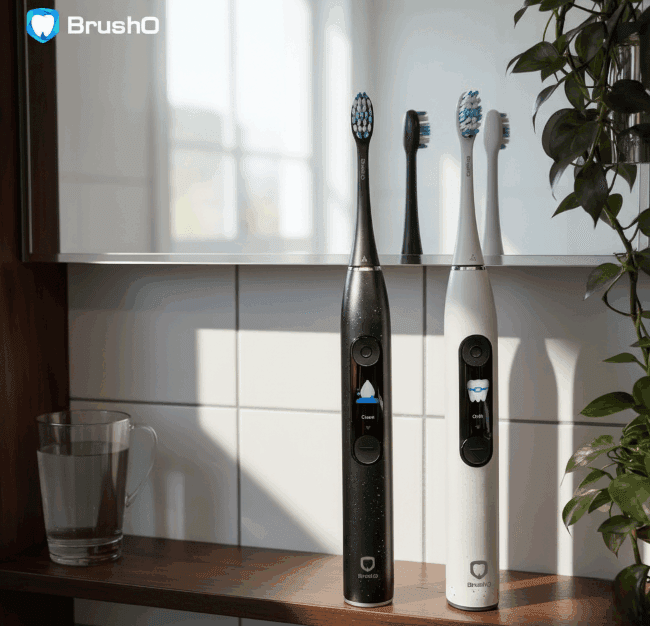
Your gumline is the area where your teeth and gums meet—and it’s often the first place bacteria settle and plaque forms. Failing to clean this area properly can lead to:
• Gingivitis (early-stage gum disease)
• Periodontal disease
• Gum recession
• Tooth sensitivity and loss
According to the American Dental Association, inflammation of the gums often starts silently, making daily gumline cleaning one of the most crucial yet neglected oral hygiene habits.
Most people are unaware they’re brushing ineffectively. Here are frequent errors:
• Brushing only the tooth surface, ignoring the edge near the gums
• Using horizontal scrubbing motions, which can irritate gums
• Brushing too hard, causing gum recession
• Spending insufficient time on each quadrant or zone of the mouth
• Neglecting the back molar gumlines, which are harder to reach
These errors allow plaque to remain along the gumline, hardening into tartar and triggering inflammation.
Proper brushing technique involves:
1. Angling your brush at 45 degrees toward the gumline (the “Bass technique”)
2. Using gentle, circular motions to sweep plaque from the gum area
3. Spending 30 seconds per quadrant, ensuring full coverage
4. Avoiding pressure—brushing harder doesn’t clean better
5. Using a soft-bristled or AI toothbrush to minimize damage
Smart toothbrushes such as BrushO are designed with gum health in mind. Here’s how:
If you’re brushing too hard—especially along the gums—BrushO’s sensors send alerts to help reduce pressure and prevent damage.
BrushO ensures no gumline zone is skipped, especially in the back molars and inner arches. It maps your brushing and reminds you to return to missed areas.
After each session, the BrushO app provides a personalized report, showing pressure zones, missed areas, and overall gumline coverage.
BrushO’s sensitive or gum-care brushing modes are ideal for users with inflamed gums or early-stage gum disease, promoting gentle, effective cleaning.
| Feature | Manual Toothbrush | BrushO AI Toothbrush |
| Pressure Detection | ❌ | ✅ Real-time alerts |
| Gumline Angle Tracking | ❌ | ✅ Smart sensors |
| Missed Zone Reminders | ❌ | ✅ Real-time prompts |
| Progress Reports | ❌ | ✅ App feedbackGum-Friendly Modes |
| Gum-Friendly Modes | ❌ | ✅ Customizable |
Your gumline may seem like a small detail in your daily brushing, but it holds the key to your long-term oral health. Ignoring it invites gum disease, recession, and eventually tooth loss. Thankfully, with awareness and smart brushing tools like BrushO, maintaining your gum health is easier—and smarter—than ever.
Jan 29
Jan 28
Jul 30
Jul 30
Jul 29
Jul 22
Jul 19
Jul 17

The posterior maxilla is the most demanding site in implant dentistry, because the pneumatized maxillary sinus frequently leaves the clinician with less bone than the implant requires. Maxillary sinus augmentation, the surgical procedure that raises the sinus floor to create vertical bone, has be...

The rubber dam is the oldest and still the most effective isolation device in restorative dentistry, and its reputation as an inconvenient extra step survives among practitioners who have never measured the time it actually saves. The dam isolates the field from the saliva, the tongue, and the ch...

The margin is the most vulnerable line in fixed prosthodontics, because it is the only boundary between the prepared tooth, the restoration, and the oral environment that the clinician cannot fully seal by effort alone. A restoration that fits seamlessly at the margin resists leakage, caries, and...

The masticatory system is built for function, yet much of its damage comes from habits that serve no purpose. Parafunctional habits, the clenching, the grinding, and the tongue pressing performed outside of normal function, sit behind much of the tooth wear, the temporomandibular pain, and the my...

Chronic mouth breathing in the growing child is seldom a dental problem in origin and almost always a facial one in consequence. The child who sleeps with the mouth open bypasses the physiologic benefits of nasal respiration, and the posture that the airway forces upon the tongue, the mandible, a...

The immediate denture is the prosthesis placed on the day the teeth are extracted, sparing the patient the edentulous interval the conventional denture imposes and preserving the occlusal vertical dimension, the facial support, and the appearance through the transition. The clinical literature ha...

The Class III malocclusion in the growing child carries a special urgency, because the maxillary deficiency that marks the pattern does not correct itself and the window for the growth-modifying treatment closes with the skeletal maturity. Elastic protraction, the orthopedic therapy that pulls th...

The denture is the only prosthetic device in medicine that its owner is expected to wear daily and to clean personally, yet it is also the device most commonly neglected until the signs of disease appear. A biofilm that forms on the acrylic base within hours is a reservoir of candida and bacteria...

The complete denture stands or falls on the impression, because the impression determines how well the base follows the mucous membrane and how evenly the occlusal load is distributed across the basal seat. For a century the profession has argued about whether the impression should record the muc...

The all-ceramic crown has moved from a niche product to the default restoration for the anterior single tooth in a single clinical generation, driven by patient demand for metal-free appearance and by materials that now survive functional loading as reliably as their metal-ceramic predecessors. A...

La brosse à dents électrique BrushO avec IA offre un guidage en temps réel, un retour sur la pression, un suivi de la couverture et des rapports de progression dans l’app pour une routine quotidienne plus propre.
La brosse à dents électrique BrushO avec IA offre un guidage en temps réel, un retour sur la pression, un suivi de la couverture et des rapports de progression dans l’app pour une routine quotidienne plus propre.


Address: RM 1427, 14/F RADIO CITY 505, HENNESSY RD CAUSEWAY BAY, HONG KONG
Code: 000000
Phone: +852-53758652
Email: customerservice@brusho.com