
Jul 30
Jul 30
Jul 29
Jul 22
Jul 19
Jul 17
Over the past decade, smart technology has transformed almost every aspect of our daily lives. Our watches track our heart rate and sleep patterns, our TVs recommend shows based on our viewing habits, and our thermostats adjust automatically to save energy. Now, in 2025, our bathrooms are getting smarter too — and the humble toothbrush is at the center of this transformation.
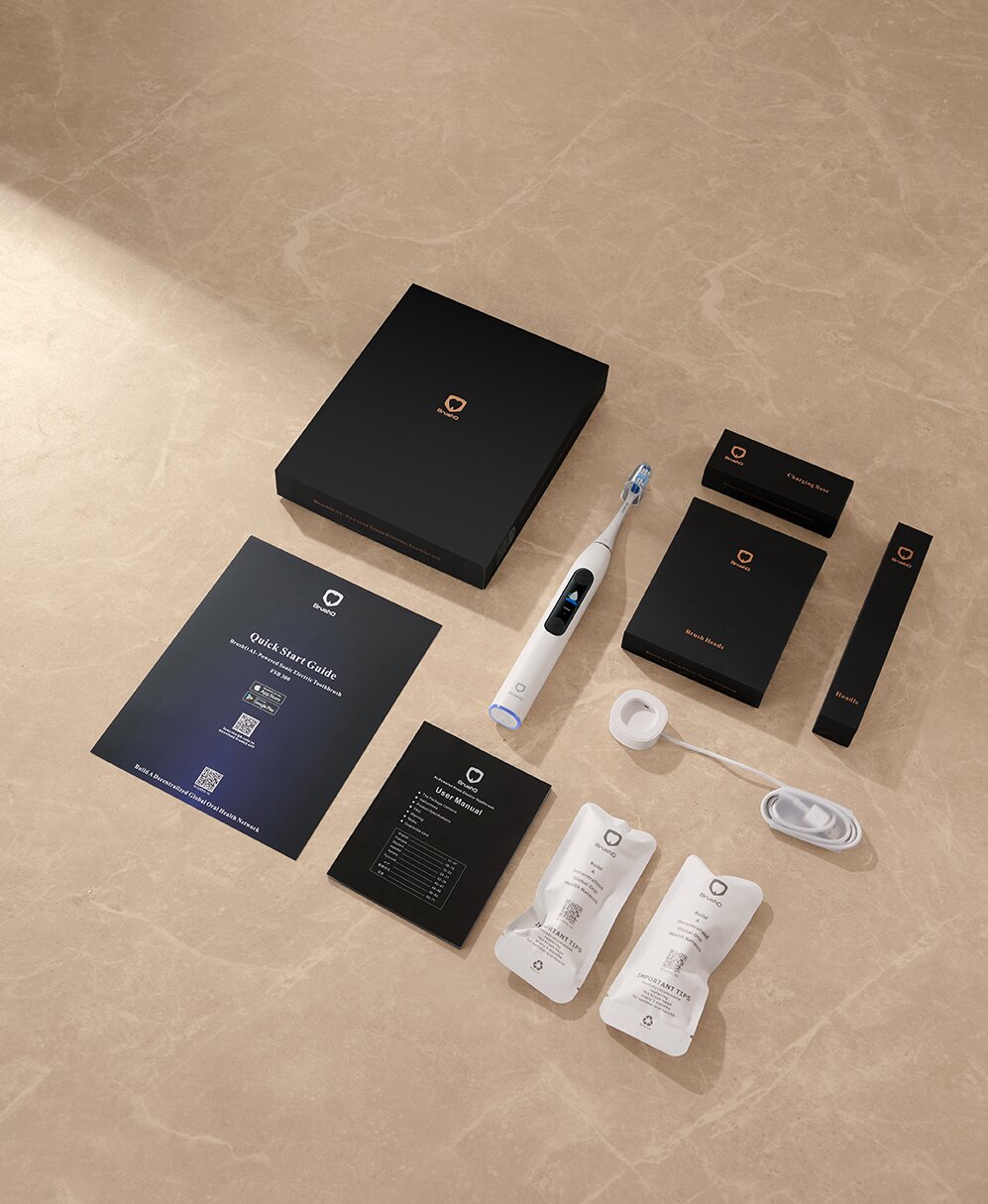
Smart toothbrushes have evolved from being niche tech gadgets to becoming essential tools for better oral health. With features like AI-powered feedback, multi-user tracking, and child-friendly brushing modes, these devices are helping people of all ages improve their dental care. In this article, we’ll explore six key smart toothbrush trends of 2025, and see how BrushO is leading the way.
One of the biggest shifts in oral care is the move from passive brushing to active, guided brushing. AI-powered toothbrushes use advanced algorithms to monitor your technique in real time — identifying missed areas, detecting when you’re brushing too hard, and even timing your brushing to ensure you meet the recommended two minutes.
How BrushO Leads:
BrushO’s built-in pressure sensors and AI-driven motion tracking work together to give you a comprehensive brushing score after every session. The app provides visual coverage maps and gentle reminders when pressure is too high, helping users protect their enamel and gums.
As families embrace smart home devices, the demand for shared, multi-user features is rising. A smart toothbrush that can store separate data profiles for each family member makes oral care easier to monitor and manage.
How BrushO Leads:
BrushO’s companion app supports multiple profiles, allowing parents to track their children’s brushing progress without switching devices. Whether it’s two kids, a couple, or elderly family members, everyone can have their own stats and feedback — all from the same toothbrush model.
For children, brushing can be a challenge — or a chore. The latest trend in smart toothbrushes is turning brushing into an engaging activity with built-in timers, animations, and even music. Gamification helps children build lasting habits while ensuring proper technique.
How BrushO Leads:
BrushO’s children’s mode plays music for exactly two minutes, keeping kids entertained while guiding them to brush for the right amount of time. Parents can also view their child’s progress through the app and offer encouragement or rewards.
With increasingly mobile lifestyles, battery performance has become a key factor in smart toothbrush design. Consumers want a device that can handle weeks — even months — between charges.
How BrushO Leads:
BrushO delivers an impressive 45-day battery life from just a 6-hour charge. It’s IPX7 waterproof, making it safe to use in the shower, and comes with wireless charging for convenience at home or on the go. This makes it a perfect companion for frequent travelers and busy professionals.
Eco-conscious consumers are demanding products that last longer and produce less waste. In the world of smart toothbrushes, this means high-quality, replaceable brush heads and durable handles that can be used for years.
How BrushO Leads:
BrushO offers multiple brush head options, allowing users to choose the right fit for sensitive gums, whitening, or deep cleaning — all while reducing plastic waste by reusing the handle.
In 2025, smart toothbrushes aren’t just standalone devices; they’re part of a larger health ecosystem. Integration with mobile apps allows users to track brushing history, set reminders, and receive personalized recommendations.
How BrushO Leads:
The BrushO app syncs effortlessly with your brushing sessions, providing detailed reports and tips for improvement. Its intuitive interface makes it easy to track progress over time, ensuring better oral health with minimal effort.
Real-world feedback brings these features to life. Here’s what BrushO users are saying:
- Family Use:
“The multi-user profile lets me track both my kids’ brushing habits without switching devices. It’s like having a personal dental coach for the whole family.” — Emily W., Parent of Two
- Child-Friendly Mode:
“My daughter actually asks to brush her teeth now because of the music mode. It’s a win-win for both of us.” — David R., Father
- Travel Convenience:
“I travel for work a lot, and the 45-day battery life means I don’t even pack the charger for short trips.” — Mark T., Frequent Traveler
- Sensitive Gums:
“I have sensitive gums, and BrushO’s gentle mode has been a game changer for me. No more soreness after brushing.” — Sophie L., Teacher
Smart toothbrushes are redefining oral care in 2025, offering more than just clean teeth — they provide guidance, motivation, and measurable improvement. BrushO combines cutting-edge technology with practical features for families, travelers, and individuals alike, proving that smarter brushing leads to healthier smiles.
Ready to upgrade your brushing routine? Discover BrushO here and experience the future of oral care today.
🌐 Website: www.brusho.com
💬 Community: t.me/brushocommunity
Aug 12
Aug 11
Jul 30
Jul 30
Jul 29
Jul 22
Jul 19
Jul 17

Fluoride in drinking water is the most cost-effective caries preventive measure in public health, and it is also the source of most avoidable fluoride exposure in young children. The balance between benefit and risk depends on concentration, on total intake from all sources and on the age of the ...

A mouthguard is the only piece of protective equipment that a dentist can prescribe, and the difference between the cheapest and the best version is often less than the cost of a single repair. This guide explains what each type of mouthguard actually protects, how to judge fit, and what to check...

Distinguishing reversible from irreversible pulpitis is the single most consequential decision in endodontic diagnosis, because one leads to a restoration and the other to root canal treatment or extraction. The distinction rests on symptoms and pulp testing rather than on radiographs alone, and ...

A pregnancy epulis is a benign overgrowth of gum tissue that appears during pregnancy, most often in the second or third trimester. It can alarm patients because it grows quickly and bleeds easily, yet in most cases it needs no surgery and settles after delivery. Understanding what drives the gro...

When several teeth are missing, the choice usually narrows to a removable partial denture or a fixed implant-supported restoration, and cost is the factor patients raise first. Upfront price is only part of the comparison, because the two options differ in maintenance, comfort, effects on neighbo...

Most root canal failures are not caused by inadequate cleaning of canals that were found, but by canals that were never located. Molar anatomy varies widely, and the variation is not random: specific teeth in specific populations have predictable additional canals. Knowing where they hide is the ...

Gum massage is one of the oldest recommendations in oral care and one of the least understood. It has been described as a treatment for bleeding gums, a route to firmer tissue and, more recently, a way to reduce brushing force. This article separates the mechanisms that are supported by physiolog...

Interdental cleaning is the part of oral hygiene most people abandon first, and the choice between a floss pick and a length of string floss is often made on convenience. Convenience matters, because a tool that is used daily outperforms a superior tool that stays in the drawer, but the two devic...

Dementia changes the way a denture is worn, cleaned and tolerated, and the people who notice the change first are usually family carers rather than clinicians. Poor denture hygiene in this group is associated with mucosal infection, reduced food intake and, in frail patients, respiratory complica...

Chewing tobacco keeps nicotine and plant irritants in prolonged contact with a small area of mucosa, and the damage that results is concentrated exactly where the quid is held. The lesions that develop are often painless, which is why they are discovered during routine examination rather than bec...

BrushO AI Electric Toothbrush offers real-time brushing guidance, pressure feedback, coverage tracking, and app-based progress reports for a cleaner daily routine.
BrushO AI Electric Toothbrush offers real-time brushing guidance, pressure feedback, coverage tracking, and app-based progress reports for a cleaner daily routine.


Address: RM 1427, 14/F RADIO CITY 505, HENNESSY RD CAUSEWAY BAY, HONG KONG
Code: 000000
Phone: +852-53758652
Email: customerservice@brusho.com