
Jul 30
Jul 30
Jul 29
Jul 22
Jul 19
Jul 17
A healthy smile is powerful—but keeping teeth white can be tricky. From coffee stains to enamel damage, daily habits often dull our smiles. Now, smart electric toothbrushes like BrushO bring professional-level whitening to your bathroom. With advanced vibration technology, AI guidance, and multiple brush heads, it’s the smarter way to protect your enamel and achieve lasting brightness.
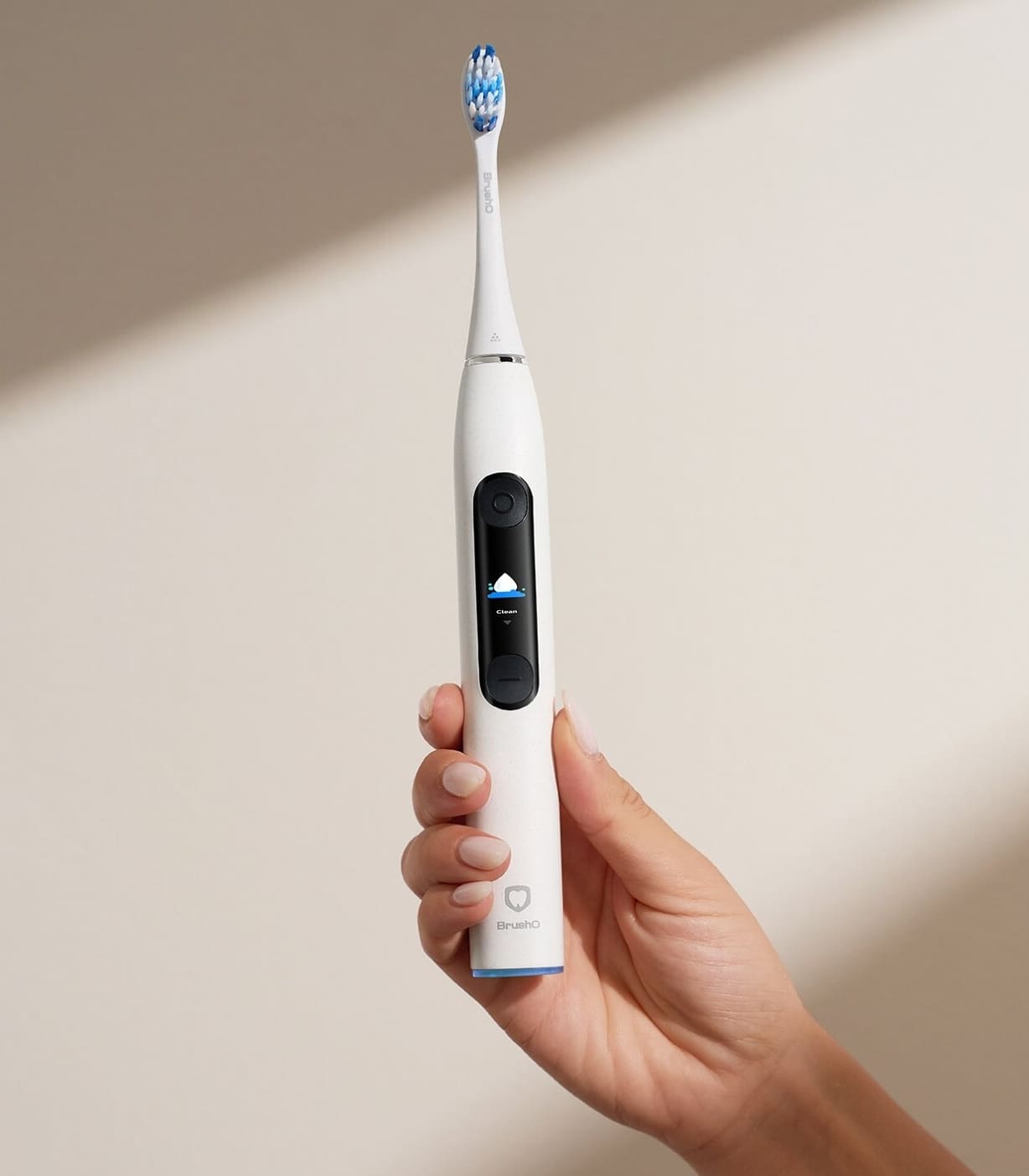
A radiant white smile is more than vanity—it signals health, confidence, and even success in social and professional life. But in 2025, we’re facing more stain-causing habits than ever: ☕ coffee culture, 🍷 red wine evenings, 🍫 sweet snacks, and even stress-related teeth grinding. These challenges make whitening not only desirable but essential for long-term oral health.
Smart toothbrushes go beyond “brushing harder.” They use oscillating micro-vibrations to gently polish away surface stains without harming enamel. Here’s how:
1. Whitening Modes – Tailored vibration cycles designed to tackle different types of stains.
2. Pressure Sensors – Automatically reduce force to prevent enamel wear while still cleaning effectively.
3. AI Feedback & App Guidance – Real-time feedback ensures even coverage, preventing yellow spots caused by inconsistent brushing.
4. Stain Prevention Tracking – Some models track dietary and brushing data, reminding users to rinse or brush after stain-heavy meals.
💡 Compared to whitening strips or chemical bleaching, this method is safer, sustainable, and integrated into your daily routine.
What sets BrushO apart? It combines technology, personalization, and convenience into one package:
✨ Three Replaceable Brush Heads – Each BrushO toothbrush kit comes with 3 different heads: standard, sensitive, and whitening. This ensures your brushing routine is always effective and adaptable.
✨ AI-Powered Coaching – The BrushO app provides personalized guidance, reminding you when to switch to a whitening head and how to optimize your brushing angle.
✨ Gentle Whitening Bristles – Specially designed bristles polish teeth while protecting enamel, preventing sensitivity—a common issue with whitening products.
✨ Sustainable Care – Instead of buying a new brush every few months, you just switch heads, saving both money and the environment 🌍.
When whitening is part of your everyday brushing routine, the benefits multiply:
🌟 Consistent Whitening – No “on-and-off” treatments; just gradual, natural brightness.
🦷 Healthier Enamel – Smart sensors prevent the over-brushing damage that makes teeth look dull.
💵 Cost Savings – Avoid expensive dentist bleaching and unreliable whitening strips.
😁 Confidence Boost – A brighter smile means stronger first impressions and more self-assurance in meetings, dates, and daily life.
Most whitening results fade because people use worn-out brush heads. BrushO solves this with a 3-head set included in every box. Each head lasts about 3 months, meaning you get up to 9 months of whitening performance without extra purchases.
That’s not just convenience—it’s a guarantee that your whitening results stay strong, consistent, and effective.
Emily, 29, Marketing Professional: “I used to spend $300 a year on whitening strips. With BrushO, my coffee stains are gone, and I don’t have tooth sensitivity anymore.”
James, 42, Coffee Lover: “I was skeptical. But after two months, my wife noticed my teeth were visibly brighter. The app coaching also helped me finally brush evenly.”
Whitening is no longer a luxury—it’s part of modern oral hygiene. With BrushO’s smart electric toothbrush, you get:
Don’t wait for stains to build up—start whitening every day. Upgrade your brushing routine with BrushO today and see why it’s the smart choice for 2025.
👉 Shop now at www.brusho.com
👉 Learn more: BrushO
Aug 20
Aug 19
Jul 30
Jul 30
Jul 29
Jul 22
Jul 19
Jul 17

Squamous cell carcinoma is not a single, uniform disease, and two of its oral variants illustrate the extremes of its behavior. Verrucous carcinoma is a slow-growing, exophytic tumor that almost never metastasizes, while spindle cell carcinoma is an aggressive, sarcomatoid malignancy that can be ...

Most people expect a toothache to be the first sign of pulp disease, but some forms of pulpitis are surprisingly silent. A pulp polyp is the visible result of chronic hyperplastic pulpitis, a condition in which the dental pulp grows out of a large carious opening as a fleshy mass. Recognizing thi...

Dry mouth is not merely uncomfortable; it is a medical condition with real consequences for teeth, speech, swallowing and quality of life. When the salivary glands cannot produce enough saliva, medications called sialogogues can restore some of the missing fluid. Pilocarpine and cevimeline are th...

A blister in the mouth can be the first warning of a systemic autoimmune disease, and two disorders deserve particular attention in the dental chair: pemphigus vulgaris and mucous membrane pemphigoid. Both produce chronic oral ulceration, yet their immunologic targets, clinical behavior and long-...

When infection drains from a tooth, the body often creates a visible escape route, and the dentist must interpret these fistulous openings correctly. A parulis is the common gum boil that signals chronic periapical infection, while an oroantral fistula is a communication between the mouth and the...

Among the fibro-osseous lesions of the jaws, the ossifying fibroma holds a unique position because it is a true neoplasm, unlike the reactive cemento-osseous dysplasia discussed in an earlier article. It grows continuously, expands bone and requires surgical removal, and its cemental variant adds...

Not all keratocystic lesions of the jaw behave alike, and one of the most important distinctions in oral pathology separates the orthokeratinized odontogenic cyst from its better-known relative, the odontogenic keratocyst. Although the two lesions look similar under the microscope at first glance...

Periodontal disease is usually a slowly progressive infection, but a rare form called necrotizing ulcerative periodontitis destroys tissue with alarming speed. Unlike ordinary periodontitis, this condition produces necrotic, cratered papillae, deep pocketing and rapid bone loss, and it appears al...

Every parent has met the child who refuses to eat because of painful mouth sores, and most of these children have one of two viral illnesses: herpangina or hand, foot and mouth disease. Both are caused by enteroviruses, both produce fever and oral ulcers, and both are overwhelmingly common in you...

Cementoosseous dysplasia is one of the most common fibro-osseous lesions found on dental radiographs, yet it is also one of the most frequently misdiagnosed. The lesion replaces normal bone with cellular fibrous tissue and cementum-like material, and it appears in several forms that range from a ...

BrushO AI Electric Toothbrush offers real-time brushing guidance, pressure feedback, coverage tracking, and app-based progress reports for a cleaner daily routine.
BrushO AI Electric Toothbrush offers real-time brushing guidance, pressure feedback, coverage tracking, and app-based progress reports for a cleaner daily routine.


Address: RM 1427, 14/F RADIO CITY 505, HENNESSY RD CAUSEWAY BAY, HONG KONG
Code: 000000
Phone: +852-53758652
Email: customerservice@brusho.com