
Jul 30
Jul 30
Jul 29
Jul 22
Jul 19
Jul 17
Waking up with a dry, sticky mouth is not just uncomfortable — it is a warning sign that your oral environment is under attack. Nighttime dry mouth, also known as nocturnal xerostomia, dramatically increases the risk of cavities, gum disease, bad breath, and enamel erosion because saliva — your mouth’s natural defense system — slows down while you sleep. Simply drinking more water is not enough. True protection requires understanding the causes of dry mouth, managing saliva flow, protecting enamel, and using intelligent brushing tools like BrushO to reduce bacterial growth before bed. This article explains the science behind nighttime dry mouth and how to prevent long‑term damage with modern oral care strategies.
During sleep, your body naturally produces less saliva. Saliva is essential because it:
• Washes away food particles
• Neutralizes acids
• Controls harmful bacteria
• Repairs early enamel damage
When saliva drops, bacteria multiply rapidly. This creates an acidic environment that attacks enamel and irritates gums for 6–8 continuous hours.
• Faster cavity formation
• Gum inflammation and recession
• Thick tongue coating and bad breath
• Increased tooth sensitivity
• Higher risk of oral infections
Water cannot replace saliva’s protective role.
Drinking water only provides temporary moisture. It does not:
• Neutralize oral acids
• Control bacterial growth
• Restore enamel minerals
• Lubricate tissues for hours
Saliva contains enzymes, calcium, phosphate, and antibacterial proteins that water simply lacks. Once you fall asleep, water evaporates quickly, while bacteria keep producing acid all night.
• Bitter taste
• Coated tongue
• Sore gums
• Worse breath than before
Several factors contribute to nocturnal dry mouth:
Sleeping with an open mouth dries oral tissues and accelerates bacterial growth.
Antidepressants, antihistamines, blood pressure drugs, and sleep aids reduce saliva flow.
Low body hydration worsens saliva production.
Stomach acid entering the mouth irritates tissues and reduces saliva protection.
Stress hormones suppress saliva and weaken immune defense in the mouth.
Without saliva:
• Sugar stays on teeth longer
• Bacteria create more acid
• Enamel cannot repair itself
This leads to “sleep cavities” — decay that forms along the gumline and between teeth.
• Rapid enamel erosion
• New cavities despite brushing
• Gum bleeding and soreness
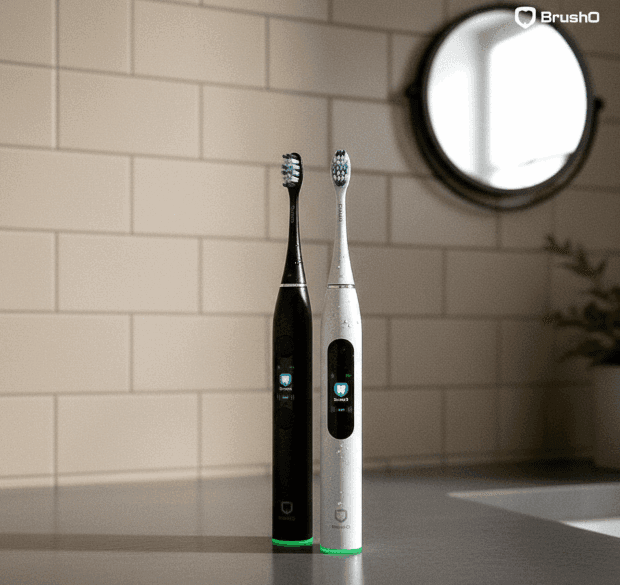
This is where BrushO makes a major difference. Night brushing is the most important brushing of the day. BrushO uses AI to ensure that your mouth enters the night with the lowest possible bacterial load.
• 6‑Zone × 16‑Surface tracking to remove plaque from every area
• Pressure sensors to protect weakened enamel
• Gum‑safe modes to prevent irritation
• App reports to reveal missed zones
• Habit reminders so nighttime brushing is never skipped
Reducing plaque before bed dramatically lowers overnight acid production.
1. Use BrushO before sleep for full‑mouth coverage
2. Floss to remove trapped bacteria
3. Use alcohol‑free fluoride rinse
4. Hydrate well before bed
5. Use a humidifier if you mouth‑breathe
6. Avoid sugar and acidic snacks at night
This creates a protective oral environment that lasts while you sleep.
Untreated dry mouth causes:
• Chronic gum disease
• Tooth loss
• Root decay
• Painful infections
• Expensive dental treatments
The earlier you manage it, the more enamel and gum tissue you save.
Nighttime dry mouth is not just discomfort — it is a serious risk factor for cavities, gum disease, and bad breath. Water alone cannot replace saliva’s protective power. The real solution is bacterial control, enamel protection, and smart brushing before bed. With BrushO’s AI‑powered guidance, you reduce the damage that dry mouth causes every night and protect your smile long‑term.
Feb 4
Jan 30
Jul 30
Jul 30
Jul 29
Jul 22
Jul 19
Jul 17

The shift from metal-ceramic (PFM) to all-ceramic restorations represents one of the most significant material transitions in restorative dentistry over the past two decades. In the United States, all-ceramic crowns now account for over 65% of single-unit posterior restorations according to the 2023

For over a century, the dominant paradigm in caries management has been surgical: identify cavitated lesions, remove carious tissue with rotary instruments, and restore the tooth with a synthetic material. Silver diamine fluoride (SDF) — a colorless alkaline solution containing silver (25% w/v), flu

Regenerative endodontic procedures (REPs) represent a paradigm shift in the management of immature permanent teeth with necrotic pulps. For decades, the standard of care for these teeth — typically resulting from trauma or dens evaginatus in children and adolescents aged 7–16 years — was apexificati

The use of autologous blood-derived products to enhance wound healing and tissue regeneration has been a focus of surgical research for over four decades. The first-generation product, platelet-rich plasma (PRP), was introduced in the 1970s and gained popularity in the 1990s for its ability to deliv

These prevalence figures have significant clinical implications. A general dental practice with 500 implant patients can expect approximately 95 patients to develop peri-implantitis requiring intervention. Unlike periodontitis around natural teeth, peri-implantitis presents unique challenges: the ab

Dental implantology has undergone a fundamental shift in treatment philosophy over the past two decades. The original Branemark protocol, established in the 1970s, mandated extraction socket healing for 6 to 12 months before implant placement, followed by an additional 3 to 6 months of submerged hea

Esthetic dentistry has historically relied on analog diagnostic tools: mounted study casts on semi-adjustable articulators, two-dimensional facial photographs, manual wax-ups, and diagnostic mock-ups fabricated by the dentist or laboratory technician. While these methods have produced excellent resu

This article provides a comprehensive review of dental sleep medicine and OAT, covering diagnostic pathways, MAD appliance design categories, clinical efficacy benchmarks, side effect management, the critical role of physician-dentist collaboration, and the emerging role of digital workflows and rem

Dental radiography generates an enormous volume of diagnostic images annually: bitewings, periapicals, panoramic radiographs, and cone-beam computed tomography (CBCT) scans. In the United States alone, an estimated 500 million dental radiographs are taken each year, according to a 2023 analysis by t

Additive manufacturing has moved from the margins to the core of modern dentistry, reshaping how crowns, surgical guides, dentures, aligners, and models are produced. According to a 2023 market analysis by Grand View Research, the global dental 3D printing market was valued at $3.1 billion and is pr

Die BrushO KI-Elektrozahnbürste bietet Echtzeit-Anleitung, Druckfeedback, Abdeckungsverfolgung und Fortschrittsberichte in der App für eine sauberere tägliche Routine.
Die BrushO KI-Elektrozahnbürste bietet Echtzeit-Anleitung, Druckfeedback, Abdeckungsverfolgung und Fortschrittsberichte in der App für eine sauberere tägliche Routine.


Address: RM 1427, 14/F RADIO CITY 505, HENNESSY RD CAUSEWAY BAY, HONG KONG
Code: 000000
Phone: +852-53758652
Email: customerservice@brusho.com