
Jul 30
Jul 30
Jul 29
Jul 22
Jul 19
Jul 17
Are toothbrush bristles really important?
Absolutely. Bristles are the first point of contact between your toothbrush and your teeth, and they play a major role in cleaning efficiency, gum protection, and long-term oral health. The wrong bristles can damage enamel or irritate gums, while high-quality bristles improve comfort and effectiveness. In this article, we’ll explore the role of toothbrush bristles, the soft vs hard debate, dentist recommendations, and how BrushO’s premium bristle design, pressure sensor technology, and four included replacement heads ensure your daily brushing is safe, effective, and future-proof.
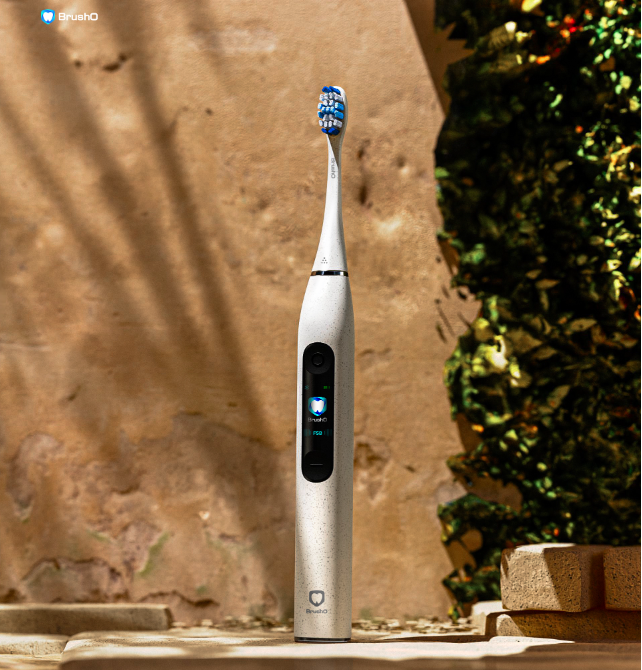
Toothbrush bristles may look simple, but their job is critical:
Without well-designed bristles, even the most advanced toothbrush won’t deliver good results.
Soft Bristles: Recommended by most dentists. They bend easily, reach between teeth, and clean effectively without harming enamel. Perfect for sensitive gums.
Hard Bristles: Often marketed as “extra cleaning,” but can actually wear down enamel and irritate gums if used daily.
👉 The American Dental Association (ADA) generally recommends soft or medium bristles, combined with proper brushing technique.
Not all bristles are created equal. Low-quality brushes may fray quickly, harbor bacteria, or fail to remove plaque effectively. High-quality bristles provide:
Poor bristles can lead to premature wear on your teeth and gums—exactly the opposite of what you want from daily brushing.
Dentists consistently advise patients to:
Proper bristles combined with smart technology are the best formula for healthier teeth and gums.
The BrushO Smart Electric Toothbrush combines advanced design with premium bristle quality to ensure safe and effective cleaning:
Designed for both durability and softness, giving a thorough clean while protecting enamel.
Enough for a full year of dentist-recommended replacements, ensuring optimal hygiene without extra purchases.
Even with soft bristles, brushing too hard can cause damage. BrushO’s sensor prevents enamel erosion and gum irritation.
From Sensitive to Deep Clean, you can pair bristle quality with the right vibration mode for your needs.
👉 With BrushO, bristles aren’t just an afterthought; they’re the foundation of effective, safe brushing.
Q1: Are hard bristles better at cleaning?
Not necessarily. They may remove more plaque short-term, but risk long-term damage.
Q2: Do I really need to replace brush heads every 3 months?
Yes. Old bristles lose effectiveness and harbor bacteria. BrushO makes this easy by including 4 replacements per set.
Q3: What type of bristles are best for sensitive teeth?
Soft bristles are safest, especially when paired with pressure sensors.
Q4: Why are premium bristles worth the cost?
They clean better, last longer, and protect your teeth and gums, preventing costly dental treatments later.
So, are toothbrush bristles really important? Without a doubt. They’re the direct connection between your toothbrush and your teeth, and their quality determines how well you clean and protect your smile. With BrushO’s premium bristles, smart pressure sensing, and multiple cleaning modes, you get the best of both worlds: effective plaque removal and long-term oral health.
Jul 30
Jul 30
Jul 29
Jul 22
Jul 19
Jul 17

Saliva has moved from the byproduct of the examination to the fluid that the modern practice can read, and the diagnostics that the salivary sample supports now reach from the caries risk to the periodontal inflammation and beyond. The fluid is easy to collect, safe to handle, and rich in the pro...

The narrow alveolar ridge is the common obstacle that the implant plan meets in the healed posterior site, and the ridge split technique is the approach that widens the crest without the block graft and the second surgical site. The technique uses the viscoelastic property of the bone, and the co...

The resin-bonded bridge is the conservative alternative to the conventional fixed prosthesis, and its place in the modern practice has widened as the adhesive dentistry matured. The prosthesis replaces the missing tooth with the minimal removal of the enamel from the abutment, and the retention i...

The systemic antibiotic has a defined and a narrow place in the periodontal therapy, and the clinician who respects its limits uses it well while the clinician who reaches for it routinely erodes both the result and the antibiotic stewardship. The mechanical debridement remains the foundation of ...

The bond failure of the bracket is the interruption that the fixed orthodontic treatment can tolerate in the small number but not in the pattern, and the clinician who understands the cause reduces the frequency that the repeated rebonding records. The failure that recurs on the single tooth poin...

The prescription pad is one of the most common sources of the oral complaint that the patient brings to the dental office, and the clinician who does not think of the medication may spend the appointment treating the symptom that the drug created. The list of the agents that affect the mouth grow...

The intraoral scanner has moved from the novelty of the early adopters to the standard equipment of the modern prosthodontic practice, and the comparison with the conventional impression has become a daily question rather than an academic one. The scanner captures the surface of the teeth and the...

The endodontic retreatment is the second chance that the tooth receives when the initial treatment fails to resolve the infection or the symptoms, and the procedure is both more demanding and more rewarding than the primary treatment. The clinician who retreats the tooth encounters the filling ma...

The access preparation is the gateway of every root canal treatment, and it is the step at which the outcome of the case is most often decided, for good or for ill. A well-designed access straightens the canal system, removes the coronal obstruction, and allows the instruments and the irrigants t...

The restoration that the laboratory returns is only as good as the information that the clinician sends, and the communication between the dentist and the technician is the step that determines whether the crown, the veneer, or the bridge meets the expectation of the patient. The shade, the form,...

Die BrushO KI-Elektrozahnbürste bietet Echtzeit-Anleitung, Druckfeedback, Abdeckungsverfolgung und Fortschrittsberichte in der App für eine sauberere tägliche Routine.
Die BrushO KI-Elektrozahnbürste bietet Echtzeit-Anleitung, Druckfeedback, Abdeckungsverfolgung und Fortschrittsberichte in der App für eine sauberere tägliche Routine.


Address: RM 1427, 14/F RADIO CITY 505, HENNESSY RD CAUSEWAY BAY, HONG KONG
Code: 000000
Phone: +852-53758652
Email: customerservice@brusho.com